
Wat Banan and Cooking School (18th November)
After a hearty breakfast of sticky rice, we decided we would go looking for one of the bakeries which the Intrepid booklet recommended, but unfortunately we found it.
Something had changed between when the recommendation was written and when we arrived at the bakery; the coffee was rubbish and they didn’t seem to be selling any kinds of pastry. So we strolled back through town, past the central market, to our hotel. Today we would be getting in a bus to go and see Wat Banan. The bus ride there was over the same sort of wide enough but very bumpy roads which are relatively easily navigated on a motorcycle, and not much fun at all in a minivan. The jolts and jiggerings were fun for about 15 minutes, but only for 15 minutes.
Wat Banan – the ‘Wat’ part means Temple, not sure what the Banan part means – sits peacefully on top of a small hill. To see the temple you climb to the top of the hill, up about 400 or so stone steps, which are lined with very solid stone balustrades, on the end of which sit ornamental carved nagas. A Naga is a sort of a nine-headed snake creature, but with all the snakes standing up together they end up looking more like peacocks. There are three main buildings, all built more than 900 years ago and dedicated as HIndu temples. Like many others they are now used either by Buddhists or as tourist attractions, or both. Our guide informed us that many Hindus do still visit Wat Banan out of interest, because of course the sculptures and layout are not of the Buddhist type.
The sculptures themselves all convey stories of significance to Hindus, usually to do with the lives of the three main Gods; Shiva, Brahma and Vishnu. Shiva is the God of destruction who destroys each universe when that universe’s time is up; Brahma creates the Universe, and Vishnu watches over things and maintains harmony. That’s not all they do; they might occasionally incarnate themselves as someone else to achieve these purposes, or make deals with each other so that they have to help each other, and so on. Yes; today’s HIndu deity is an active deity.
And the view from the top of the hill is majestic, seeing as there basically aren’t any other hills around.
On the way back to town we stopped at a winery, which was something I hadn’t really expected to find in Cambodia. Too much rain, one would think. But rows of grapes there were. At a wooden table under a hut we sat and paid 50c each for a glass of mildly alcoholic sour grape juice. Yes, it wasn’t the greatest wine in creation, but it was kind of funny to be having a beverage at 11am. Luckily they had brandy to wash the taste of the wine away, so after a glass of wine and a smaller glass of brandy I wouldn’t have minded having a nap in the bus but, you guessed it, it was a bit bumpy. And I was too busy giggling at the stranded bogged truck we came across. It wasn’t actually stuck in the mud. It was just stuck sideways on a big bump, with one corner in a big hole.
(tee hee).
We arrived back at the hotel just around about midday. The cooking school didn’t start until 3pm; we engaged in hibernative naptosis for a litltle while, and got ourselves back out of bed just before 2.30, which was in time to walk over to the restaurant which runs the school but not in time to have had anything much for lunch. It’s only about a four block walk from the hotel to the Smokin’ Pot restaurant, and everyone who was in the class was from our group anyway, so we met in the lobby and strolled on over there with plenty of time to spare.
When I say cooking school, it’s worth mentioning that most shops and restaurants in Cambodia are no bigger than 3m x 5m; our cooking school was actually conducted more or less in the restaurant, and we did our chopping on the same table we had eaten at the night before, and other tourists walked past and saw us chopping and peeling and smushing and decided ‘That looks like fun’, and signed up for tomorrow’s cooking schools. And we had a funny little man named Vannak, who wouldn’t have been much older than myself or Alice, leading the group. Like most of the people we had encountered he spoke disarmingly good english, and like most of the Cambodian people we encountered, he was pretty cheerful.
While we did have the option to choose things from the menu, but everyone was happy to go ahead with the standard menu – Fish or Tofu Amok, Beef or Tofu Lok Lak, and Vegetable Tom Yam, which is a watery soup – and we walked back over to the market to buy some bits and pieces. In the market they sell every type of food in existence, and I bought a bag of fresh pineapple for lunch, while we wandered through the market building and out the other side, to find fresh coconut, tomatoes, chillies, fish, mushrooms, and other things necessary. I was looking the other way when it happened – although the noises led me to detect something was going on – but the girls were lucky enough to see a frog being peeled. Apparently it’s just like pulling a sock off.
Hey presto – no skin.
There were all kinds of baskets of all kinds of other exotic things, and many large piles of fresh vegetables; probably the thing that stood out most was the fish sticks. They looked like they were packed in the same plastic as the thin round Kraft Cheese sticks you can buy here, only they were made of fish paste. We didn’t buy any.
At our outside table the cooking school continued, and we learned things like how garlic is easier to peel after you whomp it from above while holding the knife sideways, and how easy chilli paste actually is to make, and also coconut milk can be made by soaking the ground flesh of the coconut in water, sticking a bunch of the mush inside a cheese cloth, and, well, milking it. Presumably if you leave it to settle the coconut cream journeys to the surface. To make Amok, all you do is fry the solids and then heat up the chilli paste in coconut milk, and then wait for the fluid to boil off or soak in.
It makes something very much like a Stroganoff but with chilli and ginger type flavours; filling and tasty.
We did our chopping at the table, outside, and then moved about one metre to do our cooking inside, at gas burners, and we ate each course as it was cooked, and then began chopping the next one. I think you could safely say it was a satisfying and slow afternoon. I made a little mistake with my Lok Lak and put in more salt (none) than I was supposed to, because the sugar and the salt were in bowls next to each other. So it wasn’t quite as sweet as it could have been, but it was still not a disaster. The last and easiest course was the Tom Yam, which mainly involved chopping some stuff and then boiling it for a while. In Cambodia they have a thing called a straw mushroom which, when eaten raw, can be poisonous and/or hallucinogenic; Vannak stood watching the stopwatch on his watch, making absolutely sure that we all boiled our mushrooms for at least three minutes.
We left for our hotel fat and happy, and dreaming of being able to make such things at home.
Ella upped the ante in the spot-a-decent-bakery competition by pointing out a very decent and cheap bakery one block along from the market; we bought some doughnuts and a sweet loaf type thing for breakfast the next morning, and took ourselves back to our room, to look at pictures and write about things.
Greg






Bus to Battambang (17th November)
The bus trip to Battambang, in the west of Cambodia, was the first of a reasonably long series of early mornings.
We had to get a minivan over to the main bus station in Phnom Penh in time for our tour bus to leave at 7.45am. Lots of trips in our Vietnam tour had been marked as ‘by public bus’, but we hadn’t really seen one yet. Only minivans, sometimes with as few as four people in them. Turns out a public bus is not much different and certainly no less pleasant than in Australia; it’s a big tour bus where you stuff your baggage in the hold at the bottom, and you get on poky little seats in the top.
In Cambodia the bus goes over bumpier roads, is far more likely to dodge cows and motorcycles, and is legally mandated to use the horn every fifteen seconds. I tried most of the trip to go to sleep but couldn’t quite manage it.
But with those slight problems aside, our trip only took five hours and was a breeze. We stopped at a couple of roadside stops for toilet break and fresh pineapple and things like that. On arrival in Battambang we put ourselves in two minibuses and our baggage in a couple of tuk-tuks, and both were taken to the (insert name) hotel, as the Royal Hotel was full. The hotel has four floors, no lifts, mirrors on the roof in the lobby to reflect the chandelier light, and a rooftop restaurant and terrace. Only this time, it’s not just the top floor; it is the rooftop. So we retired up there and treated ourselves to lunch, which in my case was a very nice coconut-milky vegetable curry. We sat under the shady sails and talked to Sherry (that’ll be Sheridan then) about her trip to Africa and ours as well. Intrepid do a 150-day tour from Cape Town to Istanbul that is as enticing as it is expensive. But only in total, not according to what you get for it.
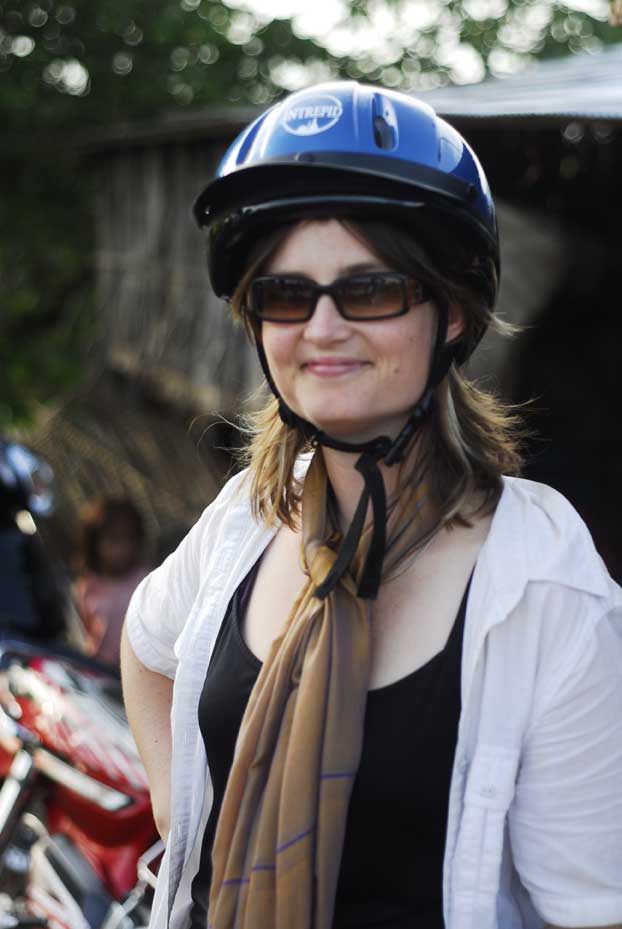
That’s a problem for later, though; the immediate challenge being whether to go on the afternoon’s optional motorbike tour around Battambang with Alice and others from the group, or whether to lie very still and perhaps go to sleep. I had until 3.30pm to decide and at about 3.20pm I had that ‘Yeah but when will I be back here?’ moment and joined the tour. I think also the free scarves, to keep dust off on some of the more provincial roads around, were a strong enticement.
As in Hue everybody had their own motorbike, rider, and helmet, but unlike in Hue there were now 12 of us, with Nak riding one of the motorbikes. That was one of his previous jobs, before Intrepid. He used to be a motorbike rider. My rider this time around was named ‘Rich’, although that must just be the English version of his name. We also had a guide, whose name escapes me at the moment, to explain to us all about the things we were going to see.
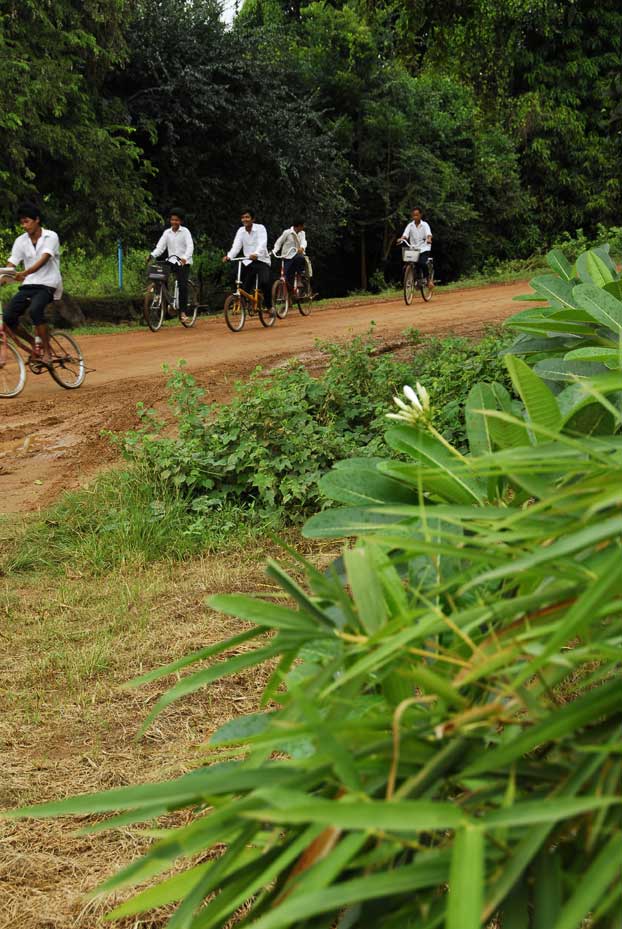
Rolling along on the back of a motorbike is quite a lot of fun. On the way out of Battambang the scenery changes rather quickly; one minute you’re in town but it’s clay-soil roads except they still have gutters and footpaths, then you’re on a dirt track as wide as a road and with more shacks than buildings lining the road, then you’re in field and the road is still wide but as bumpy as an olympic-standard bump-dodging course. Then after that you’re in the countryside, in narrow dirt lanes, zipping between shacks and villages.
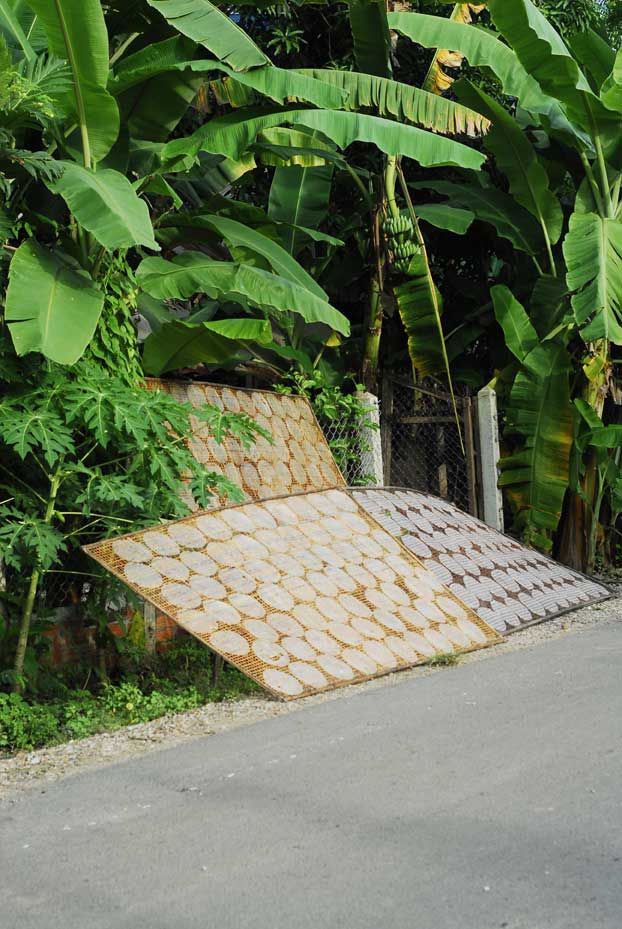
The first part of our tour was a demonstration of the process of making those thin rice paper sheets that go into making spring rolls. It’s pretty simple, really; you grind some rice finely to make flour, you mix it with water, strain it to make dough, steam it, and roll it out on bamboo sheets to dry in the sun. Sounds simple. Except that the finely ground rice flour is made more or less by hand (or with fairly basic machines), the rice paper will not dry in the wet season so the people that make the rolls have to work extra hard in dry season and have something else to do for the rest of the year, and the price of rice paper rolls is low enough that churning out several thousand rolls per day in dry season doesn’t buy you much more than a village shack.
All the same the lady making them was quite cheerful and didn’t mind a bunch of open-mouth tourists poking around and taking pictures.
Through the village we rode and then came out onto a wider, flatter road, running in between two green rice fields, with canals on either side. We stopped at a shack where the locals grew and harvested water snakes. A water snake is exactly what it sounds like. A large terracotta pot full of water snakes, that writhe toward the light when the lid is lifted off, is rather more entertaining. The thought of eating water snakes, either raw or rolled up and toasted, or in a herbal concoction to ‘cure’ arthritis, is not that entertaining at all.
We got back on the bikes and tallied-ho back down the orange road, through a smaller town and across a short but steep bridge, with levels sort of like steps but not quite, where most of the riders missed a gear. We turned left, through more bamboo plants by the river, and stopped near another much wider, flatter metal bridge, where there was a fish market. The fresh fish are bought from the Tonle Sap lake, which between wet and dry seasons can vary in surface area by more than a factor of ten. During the fish spawning season (June to October), no fishing is allowed in the mangrove areas around the edges of the lake, and this keeps everything sensible.
One of the things they do with the fish, and you can almost tell this by the smell coming from under the 15m wide by 50m long metal pergola, is making fish paste. Only they don’t have blenders or anything like that to do it. They just have long sharp heavy knives. They hold one in each hand and swing alternately, knocking the fish into very small pieces very quickly. Then they do it all again, and chuck it in a huge vat with buckets of salt to stop it going off, and wait around for two months or so until it’s all descended into a flat-topped grey mess the consistency of finely sieved clag glue. Very entertaining, really.
Further along, over more bumps and muddy patches and other obstacles calling for tidy riding, we stopped at shacks where sticky rice was being made. Sticky rice is something which everyone in Cambodia eats all the time but I’ve hardly ever heard of in Australia. It comes in different flavours somewhere between sweet and salty, depending basically on who makes it. But the real show is how it’s made. The ingredients are stirred for hours and hours, and when they are thick enough they are put inside your standard bit of bamboo; a fire is lit under the bamboo and the outside goes black. Bamboo is really quite thick; cutting off the blackened part leaves a cylinder strong enough to go in the bottom of your bag but thin enough to be peeled when you need to access the tasty rice within. Literally, peeled like a banana. Our guide explained about how people going on long bus trips would often take some sticky rice with them, because it’s very filling. And with salt and sugar you would be able to avoid dehydration.
The novelty of peeling the bamboo sides down is fun; but it tastes good and is solid enough to be easy to eat as well.
Final stop on the fresh food tour of the Battambang Countryside was another hut, near a metal bridge similar to the one by the fish paste ‘factory’, where 5 men and women were hard at work making fresh rice noodles. It doesn’t sound complicated, but again, in the absence of a nice steel machine to churn noodles out for you, they had themselves set up with baskets for rinsing and for the individual orders – people had to come and order batches otherwise they wouldn’t be made – and a big wooden bowl with boiling water in it, and a huge wooden tub with the dough. The noodles get squeezed out through a plate (presumably with noodle-shaped holes) into the boiling water, which seals them in the right shape, then pulled out in a mesh rinsing basket, which they take over to another bowl of water, to run cold water over. This done, the ladies sitting on the table get their hands involved and plait the noodles into rings. The rings go into wooden mesh baskets, are weighed, and then the order is ready.
I forget what the price of a kilo of fresh noodles is, but it’s probably not enough, for what goes into it.
The sun was trending downward; we got back on our motorbikes and motored back into town, through more bumpy roads and past makeshift shacks and along the edges of the river, bamboo all around. At the hotel we took all our pictures of our riders and then filtered up to the rooftop for a cold beverage, which we had the pleasure of adding to our Room Tab, and descended at seven for dinner at a local restaurant called ‘The Smoking Pot.’ Nak didn’t mind us knowing that a few years ago he bought tourists here for a different reason. Maybe it was legal then, or illegal but the government had more important things to enforce. Anyhow, THE ONLY thing I had for dinner was a very good and very spicy vegetable soup, in a sort of Thai style. Nak wouldn’t be the only one, we detected, who has come and gone through Thailand; the Thai influence shows up regularly.
This was the same restaurant we would be having our cooking school at the following day, for those who were interested. Rumour was that you could even pick something off the menu, and be shown how to cook that. I wanted to know how to make Vegetable Tom Yam (which is soup) and Alice wanted to know how to make Beef Lok Lak, so we put our names down for the school, even upon threat that if less than the six (6) people booked did in fact show up, we would have to split the usual cost between us. Yay!
We walked back through the town, which was now almost entirely deserted, and took ourselves to the ANZ (?) Bank, where the door of the room with the ATM in it had frosting on it. Stepping into the ATM booth, it was as I suspected Arctic.
At the hotel we put our sticky rice in the fridge for tomorrow morning; turns out sections of Bamboo do look odd inside a fridge.
Greg






S21 and Choeung Ek (16th November)
There’s two things everyone knows about Cambodia; one involves temples and the other involves torture and worse.
Today, a Sunday, we were going to see the second one. In the morning we kept ourselves to ourselves and twiddled around the hotel, once again fighting the backlog of days and days of travelling to be written about, and pictures to go with. Just after midday we walked back down Sihanouk Boulevard to the Lucky Supermarket and bought some bits and pieces like pineapple and dragonfruit for lunch, and some pastries as well, and met in the lobby at 1.30pm to get in the tour bus. This afternoon’s activities were included in the tour so we had a guide as well.
He introduced himself as Mr Heng (which isn’t pronounced the way it looks) but said that it meant Lucky and if we couldn’t remember how to say ‘Aing’ then we could call him Mr. Lucky instead. Just like Nak he started by telling his little bit of the story of the Khmer Rouge years and where he fit in; it seems most of his family is now dead so Mr Lucky sounds about right.
It’s not very far to drive to the Tuol Sleng Museum; it was actually located more or less in the middle of city blocks, which leads you to wonder how they got away with some of what went on. But they were the government, weren’t they? Tuol Sleng, the pamphlet explains, used to be a primary school, and between 1975 and 1979 there lots of kids hanging around the place but they had guns and served as guards. All of the prisons and torture centres the Khmer Rouge set up were numbered and this one was S21. There were something like 373 similar centres around Cambodia, and 169 Killing Fields.
Speaking of numbers…in April 1975 Pol Pot took over. In 1979 the Vietnamese invaded after Cambodia started launching attacks into Vietnam, and the Khmer Rouge fled the country.
In between, something like 1.7 million people were killed, although many of these died of starvation or overwork. Or starvation followed by overwork, followed by a bit more starvation just to finish the job.
So it’s good to see that directly next to the entry gate, on the left, there is a framed display case with pictures of the people who were in charge of S21, and of Pol Pot (Brother Number One) and his compadres Nuon Chea (Brother Number Two and Second-in-Command) and Ieng Sary (Brother Number Three, and Foreign Minister). Those people will be tried for war crimes sometime this year or next; and they are in jail now, except for Pol Pot who ‘died’ in Thailand in 1997. Khieu Sampan, the nominal head of state at the time, also has his picture in the glass case, and is on the list to be prosecuted for war crimes just as soon as he can be. The man that actually ran S21 from day to day – Kang Kak Ieu (aka ‘Comrade Duch’) – used to be a maths teacher, and he is also dead now. The Khmer Rouge was actually a name added on externally; the republic declared at the time, from ’75 to ’79, referred to itself as Democratic Kampuchea. Kampuchea is what Cambodia used to be called; Cambodia is actually just a corruption of the name ‘Kampuchea’, while the people who live there have been called ‘Khmer’ since the hills were made.
I’m not sure whether Democratic Kampuchea appointed a Health Minister at that time, or if so, what that person did.
But as for the centre itself… it actually was a high school before the past happened, but they won’t be using it for that now. All of the classrooms were converted into smaller rooms so that they could be used as cells; there are four main buildings, each four or five stories high, done in faded yellow paint. We only visited three of them. In Building A the individual cells are left as they were, with single iron beds that have leg and arm clamps, and a box for prisoners to go toilet in. Sometimes, if they hadn’t been fed enough, prisoners would resort to something I’d rather not repeat here.
When the Vietnamese arrived in 1979 they found zero surviving prisoners and several dead ones. The dead ones were discovered by a Vietnamese soldier, who took a picture of each of these people, and these pictures are displayed on the wall of the cell where each person was found. In the courtyard of Tuol Sleng are simple white tombs for each of these people.
The windows of the cells have iron bars in them but at the time they had barbed wire as well. Heng explained in great and meticulous detail, though not with any relish whatsoever, the processes by which inmates were tortured, the somewhat contradictory rules of the camp, which make Guantanamo look like a picnic with tea and biscuits, and also about the various means of killing those who they simply could not be bothered to torture or work to death any further. Very few were actually shot; they were beaten to death with iron bars or other agricultural implements, or had their throats slit with the sharp edge of a palm branch. It didn’t really matter what so long as they ‘saved bullets, and so long as they pulled out the weed by the root, or in other words, killed the whole family of anyone who had been arrested.
The rules of S21 were these:
1. You must answer accordingly to my questions. Don’t turn them away.
2. Do not try to hide the facts by making pretexts of this and that. You are strictly prohibited to contest me.
3. Do not be a fool for you are a chap who dares to thwart the revolution.
4. You must immediately answer my questions without wasting time to reflect.
5. Do not tell me either about your immoralities or the revolution.
6. While getting lashes or electrification you must not cry at all.
7. Do nothing. Sit still and wait for my orders. If there is no order, keep quiet. When I ask you to do something, you must do it right away without protesting.
8. Do not make pretexts about Kampuchea Krom in order to hide your jaw of traitor.
9. If you do not follow all the above rules, you shall get many lashes of electric wire.
10. If you disobey any of my regulations you shall get either ten lashes or five shocks of electric wire.
Seems a bit complex, given that all they wanted to achieve was a confession of some type so that they had the ‘right’ to execute basically everyone educated enough to count past the number 10.
In Building B they ‘stored’ the female prisoners, but in wooden cells about 1m x 2m, which were fabricated inside the concrete building. In there it’s like a maze, where the goal is to understand how such a thing could have happened.
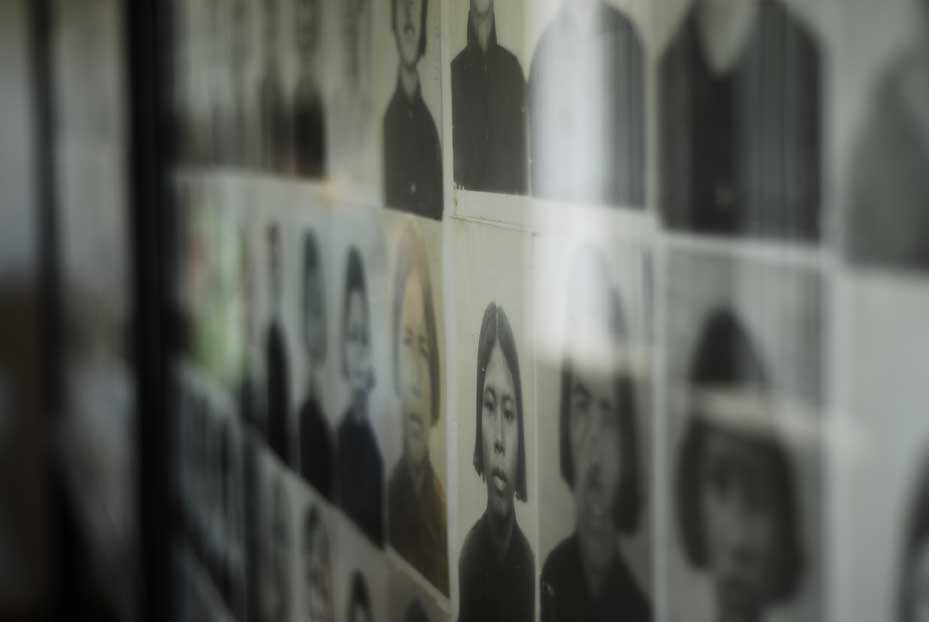
Building C is more like an exhibition room; when each prisoner arrived, just before confessing all of their crimes against the revolution, every prisoner had their photo taken, and many of the pictures are now set up inside glass cases. The people in the pictures don’t look dead but they all are. Most of them look puzzled, tired, or horrified, while some of them look like they are under 15 years old. In the same building are paintings by two of the four living survivors of S21; Vann Nath and Chum Mey. These guys were lucky enough to be commissioned to paint portraits of Pol Pot and others within the government. They were ‘essential workers.’ The third survivor was a mechanic, the fourth was a woman who I think they just didn’t get around to executing.
We toured around with Mr Heng for about an hour, and then had a 15-minute break before the drive out to Choeung Ek (The Killing Fields). We sat pretty much mute and stunned. Nak spotted us waiting and came over to see if anyone had anything to say.
‘How do you feel about this now?’ he asked me.
‘I think it’s safely the most awful thing I’ll ever see,’ I can remember saying. ‘I don’t think anyone will ever understand why it happened’ – although Heng told us several times during the tour that it was just because the Khmer Rouge wanted to create an equalitarian society with no rich and no poor – ‘but I feel like I can actually believe that it did happen.’
And then we got on the bus.
On the way out to the Killing Fields you go past some very basic and poverty-stricken accommodation, and also past the local sewerage works, where they grow vast acres of water vegetables in the open ponds to feed to pigs. We passed a large tent done up in yellow and pink, from which came loud and festive music; this, Nak explained, is what a Cambodian wedding looks like. Some people in the old days, he says, would have three days of wedding celebrations, which is a lot of pink and yellow.
Nothing really distinguishes from the surrounding countryside the fact that you are nearing the Killing Fields (or one of them, to be precise.) Until you get close there is no grave sense of foreboding and no vast collections of shadows darkening the sky. Pull up at the front gate and you can see the high stone memorial stupa, which has four sides, is about 25m high, and in the middle contains several glass shelves of human skulls. Heng made mention in the S21 museum of the fact that you can tell a male skull from a female one by the bumps over the eyebrows. Men have these and women do not; but the more noticeable feature of the skulls is how many cracks or holes of some kind in them. And in the very bottom shelf of the stupa are piles of clothes which were removed from inmates before they were done away with.
The other feature of the Choeung Ek museum worth noting is the mass graves, but today these are just flat wide holes in the ground. It’s difficult to imagine them full of corpses, and difficult to imagine being the person who first found the skeletons all stuffed in together.
Heng must have noticed everyone looking a bit flat-faced and pale – in fact that probably happens at this time on every tour – because he interrupted to tell a story about how to get an ant to crawl out of your ear. In the countryside, where such things seem to be a problem regularly, the ant will not usually just crawl out of it’s own accord. So what you do is lick your finger and rub the saliva in your bellybutton, then hold your finger there for five minutes and the ant will crawl out.
Some random dude decided that he would join our tour and listen in for a while, but he missed what kind of insect it was, and this the point of the story. Which was unfortunate for him.
After that there are some plaques telling you about the purpose of the Khmer Rouge regime, and details of foreigners who were trapped in Cambodia and were arrested and done away with, as well as some historical details like the layout of buildings and the process by which the mass graves were found and the memorial built. By far the worst part was the Killing Tree, against which some prisoners were swung feet first. Or, alternately, the sharp edge of a palm branch was used to slit the throat. I never knew it, but on closer examination the edge of the branch is serrated and the teeth are large and rigid.
And then we got back in the bus, and went back to now, where things are not quite so bad. We got back to the hotel by about 6pm, and split up for dinner. We went to a little Korean Restaurant next door to the hotel, where they recognised us as tourists (despite my fiendish disguise) and asked whether we were in ‘this hotel’ (gesturing right) or ‘that one’ (gesturing left). The two Korean men in the restaurant very funny; one tall, one short, both with those Kim Jong Il sunshades (inside at night) and both friendly. And both surprised at my interest in Kim Chi, a Korean traditional food which consists of various vegetables preserved by heavy salting, ginger-ing, spicing, or all of the above. It’s then served cold with raw onion and a sauce which tastes like concentrated boiled-down soy sauce. It’s like salt paste. But rich. It’s hideous, but goes quite well with raw white onion.
‘Make you very strong’, said the Korean man, pointing to his arm muscle.
I giggled.
After dinner we went for a little walk back down Sihanouk Boulevarde to have a look at the Independence Monument lit up at night, which was very much worth the walk.
Greg




New Tour Group (15th November)
The 15th of November was another easy lazy day.
We took ourselves up to the hotel restaurant for breakfast, and then floated around writing and being slovenly until lunchtime. We may have watched TV; I can’t really recall. After that we took a bit of a stroll around the neighbourhood near the hotel and found a Cambodian restaurant where they served us some pretty tasty noodles. And they even had some idea what we were talking about when we explained that I didn’t want beef, pork, fish or chicken in mine.
‘Ah, vegetarian?’ the lady said.
‘Yes, yes, that one!’
And so forth. It was a tidy little restaurant as well, and the only other people there seemed to be locals which is usually either a blessing or a fatal curse. In this case it seemed a blessing, for our food came quickly and cheaply.
But of course while you are slogging your backpack around Sapa or freezing in Moscow or somewhere like that you can only dream of a day to yourself in a nice hotel room, where you can be warm and do very little. The only appropriate course of action seemed to be to make the most of what we’d been offered.
At ten to six we took ourselves downstairs from Room 504 to meet the new group and new guide for our Cambodia tour, of whom there were 12 persons in total. Alan and Elaine are a retired couple who married recently, were both born in England, moved to New Zealand in the early 80’s and now live in Nelson. In their words, this is literally ‘just over the hill’ from Takaka, where my grandmother lives. Then there are Mike and Helen, a British couple who seem to have travelled just about everywhere in the face of the earth. Then there is Louise (Lou) and Sheridan, one from London and the other from Canberra (via Sydney), who became friends on a trip through Africa three years ago and have since both visited each other in Australia and the UK.
Then there are the sole travellers; Kiel (A German name for an Englishman who has been living in Edinburgh for several years, normally referred to as ‘Kilo’). Amanda, who actually works for Intrepid but has never been on one of their trips until now. Ella, who used to work in Sales and Advertising but has recently moved to a new city in England. And finally, Jamie, who works for a bank in London and in the last few years has been to Nepal, Egypt and somewhere else I’ve forgotten.
Finally there is our guide, Nak. We weren’t sure if that would turn out to be a man or a woman; but a man it was – a 33 year old man who shortens his name from Bunnak. As soon as we’d gathered everyone we then took ourselves all the way back upstairs to the restaurant and meeting room on the 6th floor to do the paperwork and hear about the itinerary and do other official-type things. Nak started by telling us all about how he was born in 1975, which is Year Zero in Cambodia, doesn’t know his actual birthdate, and spent the first 10 years of his life in a refugee camp just over the Thai border. Saves us asking, I suppose.
We even got the itinerary printed out with the date for each day, which was nice. In the Trip Notes, because they run at different times, it only ever says ‘Day 1’, ‘Day 2’, and so on. Not that it takes long to add a date to those headings, but if someone else does it for you, so much the better. And we got the country information booklet which Intrepid does for each country, and those are always handy to have.
We agreed to re-congregate downstairs at 7.30pm to go out for dinner, by which time the storm which we could see coming all afternoon from up on the 5th floor had really kicked off. We had a black out for about 15 minutes; the rain was so loud you could hardly hear any thunder. It was impressive. Of course the rain didn’t stop just because we were getting in tuk-tuks to go down to the riverside for dinner; it might have even gotten heavier, but tuk-tuks are prepared for such things and simply fold down the flaps on the side and tie them to their frames.
What tuk-tuks are not really prepared for is how quickly all the streets and intersections fill up with water, but we made it through, despite being splashed by several cars driving through the puddles. The water came up so quickly from the gutters that in some streets vehicles were taking turn about to drive down the middle of the road.
Along the riverside there are lots and lots of restaurants, some horrifically touristy and others not so bad; we went to one called Veiyo Tonle (which I guess translates as ‘View of the Tonle’ or something like that). This restaurant supports a local orphanage and teaches orphans useful skills, gives them jobs, etc. There must have been more than one Intrepid group there though, because every bit of space they had was taken up with tables of people. Everyone sitting on one side of our table had a bit of difficulty even getting into their chairs, and no one could even contemplate getting up to go anywhere.
Not that they were going anywhere anyway; as per usual the food came quite slowly and person by person, but you get used to that eventually. Because it’s a bit of a lottery, sometimes your food will come first, and you won’t starve to death watching everyone else eat in the meantime. Of course it doesn’t help going in a group of 12 and all ordering at the same time…
For a very slight increase in the fee our tuk-tuks waited around and took us back to the hotel when we were finished, which was after 9pm, The streets had dried and we rolled past the ornate walls of the Royal Palace, which some people not staying around in Phnom Penh after the tour had gone to see that afternoon.
Tomorrow afternoon we were booked in to see what Cambodia is most famous for recently; one of the Khmer Rouge prisons and the Killing Fields. I wouldn’t say anyone in the group was really enthusiastic to see such things and couldn’t wait for it; but we all definitely wanted to see it.
Greg


First day in Phnom Penh (14th November)
The 14th of November, in addition to being Dominic’s birthday, was scheduled as a recovery day.
We had a pretty slow morning and then walked down the main road near our hotel (Sihanouk Boulevarde), stopping at a bakery for snacks, and then found a bank to change the remainder of our travellers cheques. Further down the same boulevarde we came across the Independence Monument, which was put up in 1954 when the French turned tail. Further again we came to the Tonle Sap river, which stems from the massive Tonle Sap lake in the middle of Cambodia. Around the edge of this river a small army of people was very busy cleaning up mountains of bottles and garbage and other remnants of what must have been the water festival.
‘If nothing else’, we said to ourselves, ‘there definitely was a water festival.’
This leaves us with the following confirmed and unconfirmed data:
Confirmed:
1. There was a water festival.
2. The night we arrived was the last night of that festival.
Unconfirmed:
1. You are not allowed to drive buses into town on the last night of the water festival because it’s too busy.
2. There is a fee to get through the police checkpoints (although there might actually be…)
3. The fee is $5USD (and if it is why do the police wear such cheap jewellery?)
Important data we were too furious to mention in yesterday’s post:
1. The bus which ‘took’ us to ‘Phnom Penh’ was run by a company called Sapaco.
2. All the tuk-tuks swarming around the bus when they dumped us on the side of the road were wearing red shirts with ‘Sapaco’ logos on them.
3. Do not associate, tour with or otherwise engage in transactions with Sapaco ever, for any reason.
4. If you are in Vietnam or Cambodia and see anything marked ‘Sapaco’, run, and hide.
OK… deep breaths.
In a supermarket across the road from the bakery, on the way back, we bought some things like bottled water and yoghurts and emergency ice creams for a grand total of about $5, and retired to our hotel room, to compose travel journals. But in our hotel room we discovered the following piece of laminated paper, written in Khmer and then English:
Town View Hotel
Room Rules and Regulations
Dear Valued Guests!
1. Our hotel doesn’t have the sex services.
2. Drugs, arm gun, or weapon and all illegal things aren’t allowed to bring in our hotel.
3. Please don’t leave your valuable thing in the room; also we aren’t responsible for any lost item.
4. Please contact our receptionist for storing your valuable thing.
5. For your health concern, our management will visit you daily at 4pm.
6. Found items after check out are not later than 01 month.
7. Check in time at 2.00pm, Check out time at 12.00 noon.
Thank you.
The rest of the afternoon was given over to writing, looking at pictures and thinking about what sights we might like to see while in Phnom Penh. Our little 10-language 10-city guidebook doesn’t list all that many alternatives. For dinner we went all the way back to the Thai Restaurant next door to the hotel, but this time we remembered to take mosquito repellent.
Greg


A day to forget (13th November)
We were leaving Saigon at 9:00am on a bus.
The tour company office was over in Pham Ngu Lao and we had to be present and accounted for by 8.30am. So there was no danger of us missing our usual egg breakfast. We were running out of Vietnamese money, which was good because like Mongolian Togrog, it seems like no other country wants them so you can’t exchange them anywhere outside Vietnam. They don’t mind you paying with USD, so it worked out fine.
We waited for a few minutes in the bus company office before they asked to get in a minivan to be shuttled to the actual bus. But first we had to cross the road, through a swarm of motorbikes. I took one step onto the road, decided to wait for an actual gap as I had all my bags on, and stepped back only to find that there was a guy on a motorbike trying to go through the ‘gap’ behind me. Neither of us were going very fast; there was a lady on the back of the bike as well and all that happened to them was that the bike fell halfway over, against a pole. The rider must have hit his wrist on the left-hand wing mirror because he was rubbing his wrist and straightening the mirror. I didn’t even get knocked over and had a tiny graze on the back of my leg.
I managed to convey my apology via the bus company lady who came running out of the shop to see that everyone was alright, and then continued on across the road. It was more of a boo boo than an actual crash, but now I can proudly say that I have been run over by a motorcycle in Saigon.
Then we got in the ‘shuttle’ and went about 200m up the road to the coach. They loaded everything on, we got on, and we sat on the bus for about three hours until we started getting near the Cambodian border. On the way there we spent something like an hour just getting out of Saigon; said process sped up quite a bit when we reached the freeway but there was still a lot of overtaking and dodging motorbikes and honking of the horn at 4WD’s that wouldn’t get out of the fast lane.
Customs and Immigration at teh border could easily be described as a joke, except that it wasn’t funny.
Here’s what they did:
About 10 busloads of people got off their buses and walked into the square-ish white building. You handed your passport to some dude at a fold up desk who took the departure card out. The immigration hall was about five metres wide and maybe 75 metres long. After the departure card desk, for which there was no obvious line, you came to a baggage X-ray, for which there was no line at all, because that part of the hall was already filled with people lining up at the immigration booths about 40 metres away.
For the immigration booths, there was no line at all. Just a bunch of people pushing.
You put your stuff in the baggage X-ray, and pray that you can squeeze all the way around the other side of the machine before your stuff gets knocked off the edge of the roller belt. Then a French woman pushes in front of you so that she can wait for her stuff which is still halfway through the machine.
Then you join the masses pushing loosely toward the immigration desks, with no idea as to whether there might be one line for Cambodians and one for Foreigners, and no idea as to what generally is going on. Then the people who have got their passports stamped already at a window before the metal detector start trying to push their way through the crowd, but without explaining why they are doing so until they arrive near the head of the line, where resistance is greatest.
After a time – 45 minutes – we made it to the head of the queue, where there are three immigration booths, and even some two-metre long metal rails to make sure people queue properly. At the head of the line we presented our passports to the chap at the desk, only to find we were supposed to push our way through and give them to one of the guides from our bus company, who then presents them as a group to the immigration chap. Not that they took the time to inform us of this before we got off the bus.
Then you squeeze around the booth and wait on the other side for the passports to be scanned. The bus company guide calls your name out, and you collect your passport and wait outisde. If your name ends with C, you get yours first and wait outside. If your name ends with W, you wait another half hour or so. While you are waiting, you get hungry, but you also see the bus company guide take a handful of green passports and go into the duty free shop.
Then you get back on the bus and drive over to the ‘Entering Cambodia’ part of the show. The guide takes everyone’s passports and gives them to the officials, and then we all get back on the bus and go down the road to a cafe for lunch. I had vegetable soup, which was very nice, and filling too, because I hadn’t eaten for about 5 hours. The toilets were basic.
You get back on the bus and drive along for a while, then they go around and hand back the passports, this time with Cambodian Visas and stamps in them. Okie doke….
After that you stare out the window at the wide flat scenery, which is either rice fields with the occasional palm or coconut tree, or vast watery mangroves, or decrepit villages of wooden huts. You might even consider wondering how far it is to Phnom Penh from here, seeing as it’s only 250km from Saigon to Phnom Penh, and you might also daydream as far as wondering were in town our hotel will turn out to be, and whether we might get there before 3pm.
All of those things would be a mistake.
At 2.30pm, an hour from the border, we got to a traffic jam.
We sat still for one hour. Then we moved forward 25 metres. Then we sat still for half an hour, and the bus driver decided to take a short cut down a side road. He turned left, went straight for a bit, and then turned right, bringing us back to the side of the traffic jam, where we waited for half an hour to discover that the road was blocked by a metal fence and a cop, and we could not rejoin. So they set about backing the coach all the way back down that street, and then going further ahead through some narrower alleyways that the bus could only just fit through, arriving finally at another right hand turn where we saw that about 200 other vehicles having the same idea.
We waited half an hour, when it became apparrent that what the traffic jam was caused by vehicles waiting for a ferry across the river to our left. To our right now were the huge lines of vehicles we had abandoned. In front of the new line we had now joined was a metal fence, and a cop. We waited another half hour, counting how many cars could fit on each ferry and how many times vehicles from the main line of traffic were let on to the ferry without any sign of the gate in front of us moving. After all, we appeared now to be in the line of people attempting to push their way in at the side; why should we be allowed to go anywhere or do anything?
It got dark.
One ferry full of vehicles from our line went through. We moved forward about 30 metres.
At about 7.30pm we actually got our bus onto the ferry, but only just, because they had to put down wooden planks to get over some lumps and bumps on the ground.
On the other side we actually just drove off down the road, which was quite relieving. We drove along for another half-hour, during which time you might have been forgiven for thinking we were actually going to get taken to where we had paid to be taken.
No. We were not.
At what was allegedly a police checkpoint the bus stopped with allegedly zero minutes warning and we were told that because it’s the last night of the Water Festival, which is some type of big deal in these parts, they were not allowed to take buses into the city. We could get a tuk-tuk. Translation: you have to get a tuk-tuk, because we’re taking your baggage out of the bus and putting it on the ground, and when we’re finished doing that we’re going to drive off like there’s not been any crime committed.
Meanwhile the tuk-tuk drivers were swarming around offering to take us into town for $20USD. We had paid $12USD for the bus trip from Saigon to Phnom Penh; and unless I was very much mistaken we were not in Phnom Penh. Actually we had no idea where we were, so we might have been in Phnom Penh, but it definitely didn’t look like it. It looked more like a roadside dive with a petrol station, and a French couple with an 18-month old girl explaining to the tuk-tuk drivers that the taxi from the airport is $7, so how can it be $20 to get into town?
What became of them, I don’t know. After some bargaining one of the drivers agreed to take us into town for $10, which was close enough to $7 that we thought, ‘Alright then, let’s go ahead and get fleeced if it will get us to our hotel’.
He drove along for a while and then pulled over to the side of the road and stopped. Apparrently there are police checkpoints on the way into the city but they only sting drivers who are carrying tourists. So he wanted us to get out ahead of the checkpoint and walk, while he drove through, just an average guy in a tuk-tuk, and met us on the other side. We declined.
Predictably at the checkpoint we did get waved into what looked like a schoolyard where we waited around for the driver to go and get a ticket of some kind.
‘The police will ask me for a bribe,’ he allegedly said.
‘This is because you are foreigners, this is Cambodia and not like in your country,’ he allegedly said.
So then he comes back telling us the police want $5, which you and I know is somewhere near the average weekly income in Cambodia, and more than any policeman would even dream of extorting. Alice put her hand up for trouble and said ‘OK, I’ll go with you and I will pay them.’ So I sat in the tuk-tuk wondering if I was about to hear a vile scream, or if she would come back and say ‘They actually did want $5,’ or if she would come back saying ‘Ha ha, they only wanted $1’.
But we had only ashed our traveller’s cheques yesterday and didn’t have any denominations smaller than $20. So after some jiggery pokery about ‘What are you doing here?’ and ‘They don’t need to speak to you’, not from the police but from other waiting Tuk-Tuk drivers, our driver agreed graciously to pay for us and allow us to pay him back, seeing as the police didn’t have change for a twenty. All they had, Alice says, was a bit of a funny look on their face. And the driver didn’t exactly unfold and display for all to see whatever note it was that he gave to the cop.
Allegedly $5USD.
Then when we all got back in the tuk-tuk he had a bit of a moan about ‘Now you believe me, don’t you?’, but eventually we continued on down the road. After another 10 minutes or so we came to a big wide bridge, where there was another checkpoint and where our driver deferentially agreed once again to loan us some money to pay the police. $5USD, allegedly. He then informed us that we would be allowed to pay him $20USD when we arrived at the hotel. Or, seeing as how he was a bit offended that we didn’t trust him, which was probably because the price kept going up, if we wanted we could pay him $15USD and be left where we were standing.
We had a bit of an argument along the lines of ‘We only got in this tuk-tuk because you told us this would cost $10,’ and he basically tried to say ‘No, no I meant $10 plus taxes’, which was pure weapons grade balonium. But, having no idea where we were or how to get where we were going, and given that the only other form of transport we could spot were other tuk-tuks, eventually we just agreed to pay $20. Obviously the thing to do would have been to grab our bags, get off, and tell the driver ‘Your choices are now between $10 and $0; which would you prefer?’, but you don’t tend to think of these things when you’re tired, hungry and extremely pissed off.
So; we did in point of fact get taken to the correct hotel, which was nice. It took them a while to find our reservation, which was a pre-tour booking through Intrepid. We could see our names on the ‘Welcome to the Tour’ piece of paper Intrepid had posted in the lobby, so we were definitely in the right place. Actually, it took them until the next day to find our reservation, because after letting us stay there for the night they had to call the Intrepid Guide to make sure that we had pre-paid for our room.
Which we had.
And that must be the lot, you say?
No.
At 9pm we went next door to a Thai restaurant for dinner, and didn’t take any mosuite repellent with us, and got about 10 bites on each leg for our trouble.
All in all; a day to forget.
Greg


Reunification Palace and the Jade Emperor pagoda (12th November)
On the 12th of November we made a short list of the remaining things we wanted to see in Saigon and took ourselves out walking to see them.
The fried egg lady, and her close associate the iced coffee lady, were conspicuously absent. Over at Pham Ngu Lao we found that one of the restaurants was offering fried eggs with baked beans and that was a very easy decision to make. The idea was that we would wake back towards the riverside to find one of the banks around there who would be able to cash our traveller’s cheques for Cambodia, and then we would North and go to see the Reunification Palace, then further North and East to the Jade Emperor Pagoda, which was near the Binh Soup Shop – a headquarters for VC and NVLA infiltration into Saigon – and finally given time we would walk back the slightly long way and see the Xa Loi pagoda.
After Thich Quang Duc died, he was wrapped in robes by monks and taken to the Xa Loi pagoda; we did have a look and see if we could see the famed intersection on the map but it too, was conspicuously absent. And it wouldn’t have been a very tasteful thing to go and see, I guess.
In other news today was a month until my birthday! Hooray!
From Pham Ngu Lao you take yourself back along to Le Lai and walk down that way toward the river, through some footpaths undergoing major reconstruction, and into several banks who either weren’t open between 12pm and 1pm, or weren’t able to change denominations of travellers cheques larger than $200 USD, or sometimes one and then the other. Or they wouldn’t change more than $500 per person per day. And both of the cheques we had ready to go had my signature on them. And Alice, accordingly, hadn’t bought her passport. It didn’t matter all that much, except for the time we wasted walking around, because $500 was enough for the local payment to Intrepid for our Cambodia trip, and that’s what we were trying to get organised.
Cash in hand (well, in money belt…) we walked back up Nguyen Due, past the monument of Ho Chi Minh holding a small girl, and then through some glitzy shopping type streets to the Reunification Palace and the shady park across the road from the same. It didn’t feel that hot but we did feel like we were really taking a beating, so we sat in the shade for 15 minutes drinking water, and bought some coconut-y jelly sweets from a lady wheeling stuff around in a glass case on the back of a bicycle. The Reunification Palace didn’t reopen until 1pm anyway, and a small line had formed in advance, so there was no rush whatsoever.
We were delighted to find that the Palace offers free guided English-language tours, and after reflecting on how much fun it would have been to bust a tank through the front gates and declare the war to be over, we joined the tour and were shown just about everything worthy of interest. The first was the reception room, where the South Vietnamese ‘government’ sat on the 17th of April 1975, waiting for thee tanks to come on through so that they could pretend to hand over power in a dignified fashion. However the Colonel who led the troops into the Palace cut the little speech short by saying that they could not cede what they did not have.
Ooohh… Burn on that old government…
That same room now houses a golden statue of Ho Chi Minh.
From there we looked at the offices and state reception rooms, and then went up onto the second floor where there was a small interior courtyard, a pool table, and a movie theatre, and also ballrooms and space for the President’s wife to hang out. These rooms could best be described as plush, but not ornate. Huge ceilings, nice carpets, lovely furniture and so forth, but more austere in the layout; none of the ridiculous opulence we saw in the Napoleon suite of rooms in the Louvre.
But what was really interesting was all the communications rooms and command rooms on the third floor, with their maps and official-looking desks and multiple telephones. Also hidden in one of the corners up there was a library, which is of course enclosed behind a velvet rope at the present moment. On the roof there was a helicopter landing pad, so that Ngo Dinh Diem could make a quick escape when necessary; a few times before 1963 he came under attack from his own armed forces, who were either trying to kill him because they didn’t like him very much, or even sometimes because they were trying to do something more systematic like staging a coup.
Then we went down the internal stairs to the basement, where there were much more sophisticated for-the-purpose map and communication rooms, some with up to five or six phones on one desk. Also downstairs were the bunkers and kitchens and other things necessary for hiding in your own palace from your own people, as well as an old Mercedes-Benz. Finally there was an exhibition room showing pictures from the reign of the South Vietnamese government, as well as pictures of the tanks bursting through the gates, Nguyen Van Thieu being dragged away in a suit, and other important historical moments like that.
Back on the street we walked a fair way north and what felt like further east, melting more and more in the heat and getting seriously hungry. We stopped at a cafe and had some fried rice, served with pickled vegetables and what looked a little bit like pork, which had a strong reviving effect, before continuing on to the intersection where we thought we would find the Jade Emperor pagoda. Instead we found a residential district with some shops here and there, and a main road running through it. After walking a little way each way from the intersection, we asked the nice people in Vietnam Airlines who eventually directed us to the correct street. Except for the throng of sales people around the gates, the Jade Emperor pagoda doesn’t immediately stand out as being where it is; but the reward for finding it is immense.
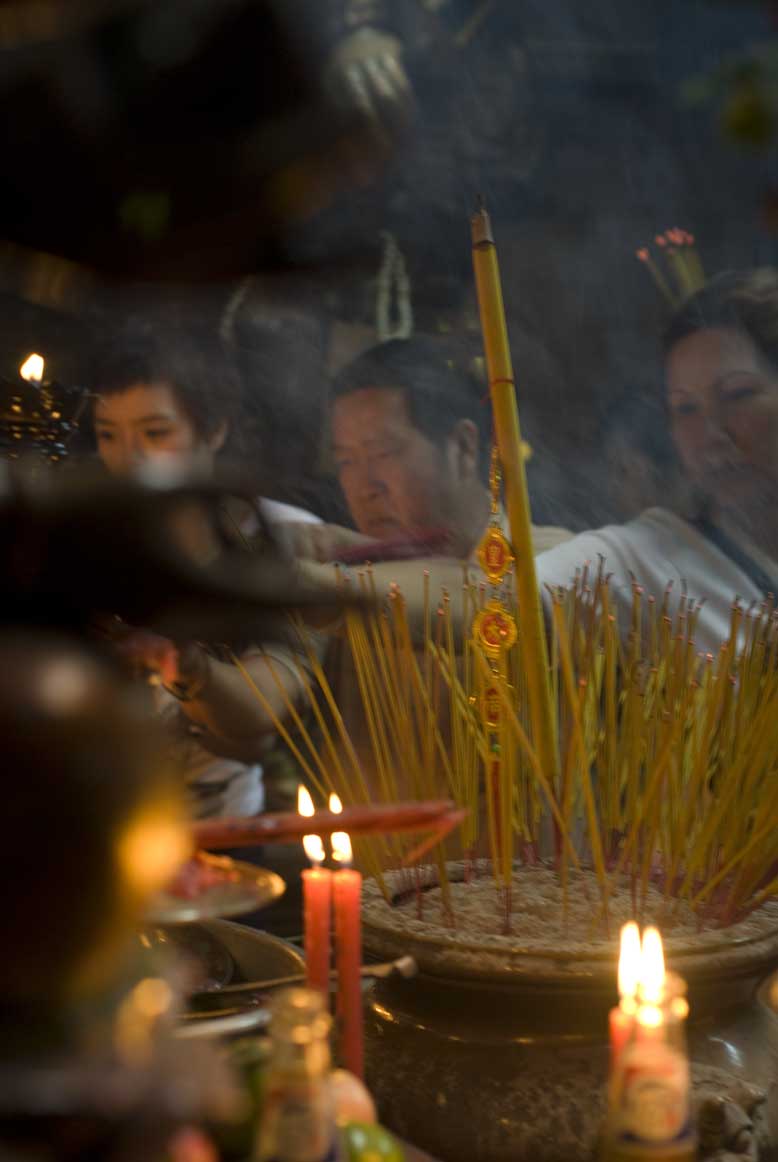
It’s not one of the museum-feeling places; it’s a real live temple, crowded with people lighting their sticks of incense and holding them in front of their heads, bowing and advancing slowly toward the main altar. There were also several small rooms off the sides of the main altar, all similarly frenetic. Up some narrow dark stairs there was even a rooftop balcony, with a stone pot full of smoking incense wedged into sand. Back inside the temple the collection of incense smoke was stifling, as the people’s hopes and prayers dispersed into the air.
Out front of the temple there is a turtle pond, and more stone incense holders, and a kind of furnace for setting the left over incense free. Many people come and go, and children giggle at the turtles, trying to climb the sides of the stone pond.
Somehow the walk back from the Pagoda, once we had abandoned all hope of reaching either the soup shop or the Xa Loi pagoda, didn’t take all that long. The afternoon was much cooler, and at 4.30pm the rush was just beginning to begin. We saw an odd thing; a whole city block of motorcycles, packed in tight and waiting in between two sets of traffic lights.
By the time we reached the Ben Thanh market, around about 5.30pm, the pineapple lady was gone, so we bought some pears from one of the several stalls. Having had such a large late lunch, that and several litres of water were enough for dinner.
Greg




A relaxing day (11th November)
On Tuesday morning Sophie could even go downstairs without fainting, so, on the promise that she wouldn’t be violently ill or nuffink we went and had fried eggs from our favourite footpath stall.
But an odd thing happened. Along the footpath leading from the roundabout, along Ly Tu Trong, something threw everyone into a huge panic. The wave of panic transferred between the footpath people; motorbike vendors, food sellers, ladies with baskets of everything, shoeshine boys; toward us at a great rate; the egg-cooking lady and her friend picked up their small metal cabinet holding all the ingredients, and the little camp-size gas burner, and ran around the corner.
Everyone else at every other table scarpered, and the coffee lady came back and rounded up the plastic tables and chairs and flung them around the corner as well.
I stood up expecting the shockwave from an explosion to arrive.
Alice and Sophie stood up, and somebody came and grabbed our table with food and coffee on it and sequestered it as well.
We looked up and down the street trying to work out what the hell was happening, with no success, and after a minute everything was bought back out, including our table with our food and drinks, not a drop or ounce of which had been displaced. We were motioned to sit back down, which we did. They had done this before.
An English speaking gent at the next table explained that there is not supposed to be any footpath business anywhere in Saigon, but particularly not in the middle of town, where they don’t really have space for such things. And yet; there is quite a lot of footpath business going on everywhere in Saigon, particularly in the middle of town. So every know and then the Federales ride past to give people a hurry up, and sometimes they even impound a bunch of property and make you pay to get it back. Or he might have said that the footpath business is legal, but you have to pay for a licence, and nobody wants to pay.
Very amusing.
About 10 minutes later, when we were actually nearly finished eating, the whole scene started up again. We got up and walked away from our table much quicker this time, so that they could get it out of view with maximum efficiency, and did even get to finish our breakfast. Which was nice.
We said goodbye to Sophie and then waited around for a video call which had been set up with Alice’s grandmother at one o’clock, which is five o’clock in Australia. It was good to talk to Granny again; we were all done and dusted by 2pm and then we walked the three or so blocks back to the Clinton restaurant where we both nearly died of starvation waiting for lunch to come. We were pretty hungry when we arrived, but at least it was after lunch time rush so there were about six people in the whole restaurant. I took a picture of Alice so that in the future when she is rich and famous they will be able to prove that she did eat at that restaurant; then they will finally be able to take down that picture of Clin-ton which doesn’t even have Hilary in it.
I had a coconut juice which came in a real cut-open coconut.
With a late lunch under the belt, and another fresh pineapple and some pears from the market, we didn’t have dinner that day.
Greg.


