Sun, sea and snorkelling (26th November)
This morning we discovered a wonderful thing. Our hotel does baked beans, fried eggs, grilled tomato, and (for those who enjoy such things) bacon for breakfast. They also do a very reasonable lemon juice and white coffee.
So after indulging in a hot breakfast we then met up with the rest of the group to venture out into the heat in Sihanoukville.
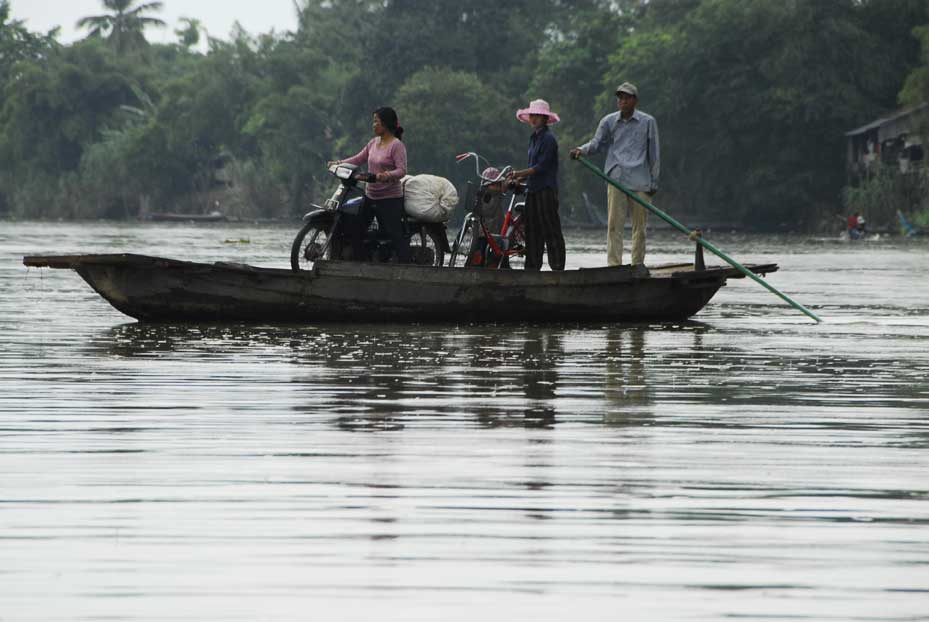
The beaches here are long and white, and the particular beach we are staying near is also lined with Asian style shack bars and restaurants – all with lounges and easy access to the water. However today we had a private long boat (painted green and graced with a blue tarpaulin canopy) to take us out for a day exploring some of the nearby islands.
Even at 8.30am when we met up you could already feel the sun seriously heating up – it was forecast to be about 32 degrees but it felt that temperature at 9am already – so it was nice to be on a moving boat, complete with sea breeze and shade. The boat pulled up to the beach and we waded into the water and took ourselves aboard up a short ladder. Somehow in the process of doing this everyone manages to sit on the same side of the boat, which is great for balance.
After half an hour motoring we anchored about 100 metres off one of the islands and kitted up with snorkels. All around the islands was a coral reef, with schools of fish darting around. Greg had never been snorkelling before, so after adjusting to breathing underwater, he was off – in fact he was the last person to get back on the boat about 45 minutes later.
(I found the water a bit choppy, and it also took quite some effort not to float too far from the boat because the current was quite strong, so after about 10min I got out.)
While Greg swum the rest of us retired to sit on the boat and fish (or watch others fish). It was serious business as we intended to cook the unlucky catches for lunch. All in all about 6 decent size fish were caught – some tuna and some that our guides didn’t know the name of in English.
So when all the bait was finished (and we had caught Greg as well) we pulled up the anchor – which actually took some doing as it was wedged between two bits of coral – and headed for a beach.
The island we landed at was called Koh Preus and it had a long, long beach, with shallow flat water that was a beautiful glistening jade colour. Way too inviting given that it was heading for midday and it was hot; we slathered on more sun screen and jumped in. The top layer of the water was serious bath temperature, but at about 20cm deep is was a refreshing cool.
While we played around in the water (I floated blissfully, while Greg kicked a volleyball around with some of the other guys), our lunch was being barbequed on the beach. (Side note: I only kicked the volleyball once – it looked like a proper volleyball but was actually one of those harder plasticky type things, so although I managed to drag my leg out of the water in time to do a perfect fly kick which almost went straight back to Alan, who threw me the ball, it really, really hurt my foot. After that we resorted to piggy in the middle and frisbee. All great fun while waist deep in tropically warm water). At about 12.30 a banquet of baguettes, fried rice, chicken and pork skewers (or tofu for greg) with vegetables and salad was delivered onto our beach blanket. And while we worked on devouring that the fish from the morning’s work was fried, and came out as a second course. There was also Sprite, Coke, and chilled water.
We then had until 3.30pm to wander around, play in the water and just generally do not much. I went to sleep in the shade before venturing back into the water, laying in the shallow water that was in the shade of the boat.
Greg went on a “photographic” mission, before returning jumping back into the water, and then collapsing onto the sand for a nap.
When we had arrived there had been another group of tourists further down the beach – but they disappeared at some point, I didn’t even see them leave, and we had the entire area to ourselves.
We had been promised another snorkel in the afternoon, but by the time we dragged everyone from the water and rounded up the adventurers it was already quite late so we headed back towards Sihanoukville, much to Greg’s disappointment.
The more beautiful part of the trip back was the impending sunset. Some clouds had gathered and the rays of sunlight were penetrating through onto the water. It was just an amazing colour – it was as if someone had got a dark blue texta and drawn on the horizon, and then coloured the rest of the sea in a light jade. I had never seen such a pronounced change of colour of the horizon before.
Even at this point the sun was baking hot, so I had a towel wrapped around my shoulders to shade them. I escaped the day with only a minor amount of sunburn. Meanwhile Greg’s back (and only his back, with a visible line along the ribs) was looking a glowing shade of red. The dangers of snorkelling.
After we returned, near to 4pm, we walked the 200 metres from the beach to our hotel, stopping midway to buy more water (I don’t know where it keeps disappearing to) and ice creams; we then showered, changed and prepared for our down town adventure.
We needed to procure some more cash, so we hired two motorbikes for 2 dollars to drive us into the main part of town (the tuk tuk driver wanted $3 so it was an easy choice). We flew past Amanda and Ella, who were walking into town, feeling that back-of-the-motorbike freedom. There is a main street which leads to the local town market. It is wide and filled with motorbikes. The main part of town here very much still feels like a rural Cambodia town – it is dusty and there are lots of little family owned stores, and urchins, as well as European tourists. We found the supermarket which also did a busy trade in exchange, as all the banks shut at 4pm, and also discovered they sold bottles of red wine for $5. It took all our strength to walk out of there without purchasing any. But we had dinner on our mind – as it had been many hours since we had eaten at midday.
The walk back took us past the restaurant where last night’s delicious Amok had been served – standard protocol would be not to go to the same restaurant, because it might be a while before we go back to Sihanoukville, but we figured if we ordered something different that would be OK and went in to sample their fresh fish and chips. It was wonderful.
On the way out we discovered our tour leader playing cards with friends out the front. They had rolled our a large mat and were sitting around eating and drinking (the restaurant was kindly serving them as the owners were friends of Nak’s), and playing cards for what were probably low stakes, but having lots of fun.
By this stage Greg and I were pretty ready for bed. So we headed back to the hotel with only one photography stop (Greg wanted to photograph the statue of the giant lion in the middle of the round about – many of the towns here have animals as their symbol, and they then create giant statues of them complete with giant testicles and place them in the main intersection).
When we got back to the hotel I put Juno on to watch and Greg promptly fell asleep. It was a lovely way to end the day.
Alice




Sihanoukville and starfish restaurant (25th November)
On the 25th of November we shuffled on down the coast a little bit from Kampot to Sihanoukville.
Kampot isn’t quite on the coast, although it is pretty close to Kep beach, which we went to yesterday, but Sihanoukville is famous for being ‘the beach resort’ in Cambodia. I think it’s safe to say everyone was looking forward to hitting the beach. And no one had malaria or dengue fever! Yet.
There’s no public bus between Kampot and Sihanoukville; you can get there by hiring two vans, which means you can leave at 10.30am, which means you have plenty of time for breakfast for a change, and it means you can have a bit of a sleep in, and that was very much what the doctor ordered.
Kep used to be famous for being ‘the beach resort’ in Cambodia but the old majestic houses are now visible only in the front garden walls near the seafront. Sihanoukville is a different matter.
The bus trip was pretty nice, actually, flinging through the countryside in relative comfort, five people in a nine person van. I had my headphones in and was listening to music from my phone. Listening to music from your phone, especially when they gave you a free 1GB memory card when you got the phone. Listening to Led Zeppelin makes it even better. Just outside Sihanoukville we came across some sort of factory, either for shoes or clothes or both, at the precise moment that about 400 orange clad workers came out the front gates for a snack break, and the snack stall owners couldn’t have looked more enthusiastic.
Sihanoukville is named after the old King Sihanouk, who departed from the throne around 1970, and also after the many Kings Sihanouk before him. But before it was known as Sihanoukville, it was called Kampong Som, which is how some Cambodians still think of it. It’s a surprisingly large and spread out town, and you can feel the beach coming as you drive along. We drove down one of the leafy streets and the two vans pulled into an alley, where we found the Starfish restaurant. It’s run by the starfish foundation, which benefits disabled people. The restaurant and shop are also staffed by disabled people.
The starfish reference is from a Buddhist parable where a master is walking along the beach, covered in starfish washed up by the tide, and stops to pick one up and return it to the ocean. ‘But master,’ says the pupil – as all pupils says in Buddhist parables these days – ‘why do you bother when there are so many you cannot help?’ Or words to that effect. ‘It doesn’t make any differecnce,’ says the pupil. “it makes a different to this one’, says the master, as he puts the starfish back in the ocean. And so forth.
The tables outside are crowded over by durian trees, and the word is that durians fall from the tree when ripe, and that can be at any time. Nobody was all that eager to sit under the durians, seeing as they’re kind of spiky in addition to smelling like rotting corpses when cut open. We luxuriated in the sun and the comfy chairs and the appetising menu. We ended up getting the mediterranean sandwich, which is basically a salad sandwich, but with things like marinated eggplant and red capsicum, hummus, red cabbage, carrot and all that kind of stuff which goes well with a proper espresso, which I had finally managed to lay my olfactory nerves upon.
After lunch we had a good look around the shop, and I wanted to get a orange t-shirt which had a white band across the middle and ‘Cambodia’ stitched upon in the band in green. It was pretty funky. But they had large, which could be used as a parachute, and small, which could be used to increase blood pressure as desired, but no medium. So no t-shirt; but we did pick up a bunch of cool stuff as souvenirs and presents and whatnot.
From there it was a short ride down to our hotel, where we set about some old-fashioned sink washing and quickly turned our otherwise comfortable room into a chinese laundry, what with the wet clothes hanging from the window frames and that type of thing. Then we strolled on down to the beach, which is long and narrow, and fronted all along with various types and qualities of shacks and huts. Jetskiers and boats twiddled a little way out from the shallow water, which was warm with hardly a wave in sight. We swam back and forth in the sun, taking it very easy.
An hour or so later we walked the 500m back to the hotel, and decided that the hotel pool looked like a pretty good place to be. The usual quota of fat sunburnt Europeans, of course, but there’s nothing to be done about that. It wasn’t as warm as the ocean, but definitely warm for a swimming pool. Amanda, Jamie and Ella were splashing about too, and had been wondering whose room had all the laundry hanging up. Sherry and Lou came in from the beach, and we lazed around in the water.
Another group dinner was afoot, but being starving as we were we tried to fit in some garlic bread from the hotel restaurant, which of course took ages and they were just about to leave without us, but the kitchen wrapped it up for take away. That filled the little afternoon tea hole, but predictably we waited a while for dinner. Seems we just weren’t learning about the perils of going out in a large group. Along the road back into the main town of Sihanoukville there is a biggish roundabout, ornamented with two large golden statues of lions. Nothing remarkable about that, except that they seemed – how can I put this? – well-equipped… seems like in the west we make our statues so as not to be overly realistic, but in Cambodia they make their animal statues balls and all.
And I wasn’t the only one to notice, for the record.
The restaurant owners were friendly and knew that they were keeping us waiting, but there was nothing much that the three of them could do about it, except for deliver drinks quickly, which they did. But when dinner came – what a dinner! Anyone who ordered amok found themselves with an empty coconut full of creamy spicy loveliness. And they left the restaurant with 8-month food babies. A good time was had by all, you could say.
And it wasn’t far to walk home.
Greg


Sun, salt and pepper (24th November)
The 24th of November has to rank as one of the more amusing days that we spent in Cambodia.
Let me tell you why;
Our breakfast was late arriving, because we woke up late, and then we decided that rather than skip breakfast we’d chance it and order muesli, which should come quickly – yes? – but it didn’t and when it came it had, despite it’s obviously enticing outward appearance of fruit and yoghurt, it had, as we should have suspected, a hell of a lot of ants in it. And then we left nearly half an hour late for our day trip because we were waiting around for breakfast.
Another reason;
Our visit to the salt farm, where important white crystalline substances are harvested, took up about 10 minutes. Basically, we got off the bus, the guy pointed at the salt fields and said ‘these are the salt fields, and that over there is the bus, now get back on it’.
The kids looked all disappointed after we didn’t give them any money for following us around during our tour of the limestone cave in one of the nearby hills which had a small altar in it that was several hundred years old. And we saw a monkey trained to sit on top of a pole.
As for the altar itself, it was only about two metres high and two metres wide, and most of the space inside was taken up with the statue that formed the altar. The door was something under 1.5 metres high, and about half a metre wide. And it was pretty dark inside the cave. So you can imagine how dark it would be inside the altar.
A fourth reason;
After the morning’s salt field we went through a little bit of a rain storm to a pepper farm; out the back of which a man stood proudly in front of two large barrels of rice alcohol, rumoured to be somewhere in the range of 80%. Tasted like 80%, and burned like 80% as well. Pepper actually grows on thin green trees, which are tethered in long rows like wine, in the thick clay soil, muddy after the rain.
A fifth reason;
Lunch, a filling and delicious vegetable amok, was eaten in open-sided huts by the beach, swaying in hammocks, and afterwards we spent a good deal of time lazing about in the sun-warm water, watching the shoals of tiny little fish buzzing past us, some of which were jumping out of the water in groups at any time they felt appropriate, while some pasty flabby european lady made an attempt to do Butterfly stroke which would have attracted lifeguards had there been any present. after which we retired back into the shady huts for cold carbonated beverages of the type which every growing boy enjoys.
A sixth reason;
After a much longer bus trip, the long flat boat which came to get us at the edge of the Kampot river spat out so much diesel smoke and exhaust powder into the river that I was surprised the boat could move with our whole group on it.
A seventh reason (yes seven!);
We stopped for a swim half way along the boat cruise, and practiced the fine oriental art of jumping off the side of the boat, or, in some cases, off the side of the top level of the boat, hopefully without destabilising the boat too much, seeing as it already had a quite a degree of yaw rotation happening, even in the calm water of the river.
An eight reason;
A couple of times we actually thought the boat was going to tip right over, and it would have been funny if it did, but only long after the fact, after the nice insurance people decided to buy us a new D200.
A ninth reason (three times as good as the third one);
Just as we were reaching our destination back in Kampot, some absolutely enormous clouds came over, and it got very dark very fast, and the people on the mezzanine level of the boat had to come rushing down the ladder, and then we skipped off the boat onto wet land, and scrambled up the hill and across the road into the closest bar, which was a decadent two-story open air deal, kind of palatial or, you might say, like what you would imagine Flavio Briatore’s house would be like – only with no supermodels laying about the place being absolutely useless and looking great doing it – this bar turned out to be a cocktail bar of the expensive variety, but it was just as good a time for hot chocolate as any. And lo, there was hot chocolate, and the people looked upon the hot chocolate they had ordered, and it was good.
And that’s all the reasons, but they’re pretty good reasons, aren’t they?
No wait – there were more!
Dinner was projected to be late arriving but I ordered the Khmer style vegetable noodles and Alice really really wanted pizza so pizza she had. Only it took about 45 minutes, and the Khmer noodles came about 10 minutes after we ordered. So I was long finished by the time her dinner came.
And finally – certain members of the group, having stayed on at the cocktail bar near the river – arrived back at the hotel looking and acting like they had maybe one lemonade too many.
Greg




The Bus to Kampot (23rd November)
There must be some law in Cambodia about how early in the morning buses are to leave.
Also we had the fun of piling our baggage up high on some tuk-tuks and biding the tuk-tuks off to the bus station, which was only 500m away from our hotel, but why carry your bags if you don’t have to, particularly if the guide pays for the baggage transport. That is to say, Intrepid paid for the baggage transport after we paid them, so we’d already paid for it.
But at least they don’t mind coming to get you from your hotel on the way to the station. We had been in Kampong Cham for about 20 hours and spent maybe 8 of those asleep, but just the same I’d be happy to come back and hang out on a tobacco farm getting counting lessons from kids any day. And there’s more stuff to do around Kampong Cham that we didn’t get anywhere near; obviously there’d be some temples around the place somewhere to look at and further up the river there are a breed of fresh water dolphins that just go back and forth along the Mekong like gypsies.
So anyway there we were on another bus, reasonably comfortable one, though, when it comes to that, except that the air conditioning was set to arctic again. This makes it difficult to get to sleep. It makes it difficult to be anything other than rigidly alert. But when your guide speaks Khmer and can ask them to turn it off for a bit this isn’t so much of a problem. Due to the vagaries of roads we had to go back to Phnom Penh first, which was fine, except that we had to change buses there, and have a lunchbreak in the middle, so we wouldn’t be getting to Kampot until after 6pm. Maybe even 7pm, said Nak, because the road to Kampot can be very bumpy.
There must also be some laws about buses stopping at roadside spots, because again, just about half way along, we pulled up with some other buses going in our direction or in the opposite one, and first thing off the bus is that the 12-year old girl selling pineapple and things like that decides that a good sales technique would be to grab men by the arm and say ‘Oh this one is my boyfriend, you want pineapple?’ Luckily there was no one from World Vision or UNICEF watching, so I managed to avoid what would have been a rather inconvenient jail term.
So we had a nice running joke going where this girl’s friend then goes and grabs Jamie by the arm and says ‘Well this is my boyfriend’, and he then with typical British correctness says ‘I think I might be a bit old for you. How old are you? You’re 11. Yes, sorry, I am a bit old for you, sorry.’ At the roadside stop interested persons could once again avail themselves of fried tarantula (I don’t think it was battered or anything), and so a couple of interested persons decided that they would actually try it again just to make sure they didn’t like it.
Back on the bus I guess we must have either watched the wheels go round or perhaps gone to sleep for a bit; eventually we came across the huge concrete bridge that spans the Tonle Sap river. Not much later we were putting our bags into a luggage storage area at Phnom Penh station which didn’t have nearly enough space for this amount of luggage, so it just went in a pile in front of the counter. No surprise, really, as the bus station is really more like a carpark with an awning next to it. But a lot of buses do come and go. Near the bus station is the Central Market and the accompanying concrete/glass/modern shopping centre, which has a food court which is perfect for lunch for tourists.
I had my usual fried rice with vegetables and a fresh whole coconut with a straw stuck in the top of it, and then we zipped downstairs to transfer some cash at the internet cafe and then find an ATM to withdraw that cash down on the corner. All in time to be back at the bus station at 12.30 for our next bus. But that bus wasn’t leaving until 1.15pm so we ended up waiting around a little while. Along the edges of the plastic awning at Phnom Penh station some clever person has installed water spray jets, to dispense a cooling mist onto the ticket holders waiting patiently on lines of concrete benches. I made a mental note to avoid any possible means of inhaling or otherwise ingesting this mist, although no one at the station seemed to be coughing or have any noticeable black pustules on their bodies. But they typically grow in the armpits, don’t they?
On the bus I retrieved the Angkor Wat book and spent most of the afternoon reading through bits and pieces of that, remembering what it all looked like, picking up some details about the mythology that I had obviously missed while taking photos instead of listening to Nak, and Alice went back to sleep for a bit. Just before 4pm we stopped at the obligatory restaurant/car park type thing and invested in mangoes. It was just as well we stopped too, because my eyeballs were starting to float.
We switched seats for the afternoon shift and I continued reading while Alice had a good time poking the video camera out the bus window or taking pictures at random intervals, seeing as any concerted effort to get a photo from a moving bus had been proving ineffective for more or less the entire duration of our trip thus far. As we got closer to Kampot we saw that thing which is rather rare in Cambodia; mountains. The wide flat green rice fields now had something behind the coconut and palm trees poking up out of them.
In those mountains, somewhere, is the Bokor Hill station, which was a French colonial outpost but is now pretty much abandoned. Previous Intrepid itineraries have included a stopover at Bokor but the news is that the road is not in good enough condition. You can’t get up there. But you can wonder about how mystical it must be, in the fog and whatever, and you can also have a little giggle about the paragraph in the Intrepid booklet which explains that during the civil war before the Khmer Rouge took over, some of the old buildings were damaged. What’s funny about it is that most of the battle took place with the government soldiers holed up in the church while the Khmer Rouge based themselves in the casino.
After 5pm the long-awaited bumpy road came to pass, and we spent something like an hour nurdling up and down at about 20km an hour, over some small hills that looked like they should be on a ski course instead of a road. A couple of times the bus scraped over the top of a bump, but you get that with the big jobs. The sun wandered off to do other things and we rolled on into Kampot, with a majestic sunset happening out the left window of the bus. At the Kampot guesthouse we reconstituted our luggage and got shuffled off to various different rooms, in which we were amazed to discover, yet again, the presence of wireless internet. Cue frenzied uploading of photographs onto our website. At 7pm we went into the restaurant of the hotel, which just like in Siem Reap was housed in some open-air open-sided tropical huts, and just like in Seam Reap we waited a fair while for various parts of everybody’s dinners to arrive, and we invested in a bottle of wine and played cards for quite some time.
Greg



Island on the Mekong (22nd November)
In the morning our breakfast was late; there was a little bit of a kerfuffle because we’d explained about how we were leaving at 7am; so somebody went and woke up somebody and our breakfast arrived pretty quickly thereafter, with a bit of banging and scuffling through the kitchen door and some rushing around, while everybody had a little look at their watches because we knew we had to be on the bus to the next town by about 7.30am. Again.
Luckily everybody who wanted something to eat got something to eat, and we walked down the dirt road out the front of the Tigre de Papier to meet the bus, which was going to come and meet us at our hotel but couldn’t make it all the way down the dirt road. On the bus we drove across town to the bus station, where women sold whatever was balancing in the baskets on the tops of their heads. Do they instruct people to buy from one side only, or if there are two people, do they have to buy from opposite sides of the head, so that the basket contraption may remain balanced? Who knows the answers to these important questions, when we are just more tourists on the way to Kampong Cham, where the locals are rumoured to cook and eat tarantulas?
The bus trip really describes itself. We sat, we watched, we made definite and concerted attempts to sleep with hats over our faces.
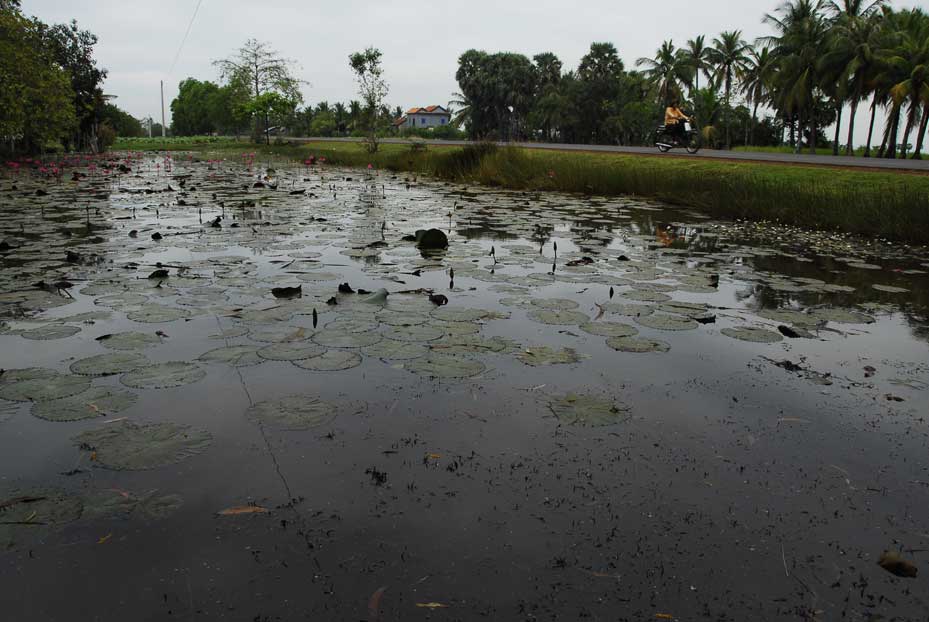
We stopped at a roadside stop for fresh pineapple and toilet breaks and that kind of thing. Several other very similar looking buses stopped with us. I went off to take pictures of the road and the motorcycles and the people in colourful clothes and the huts with ponds full of lilies in front of them that reflected nicely the palm trees growing behind. I took pictures of the colourful people on motorbikes reflected in the ponds which were in front of the huts that had palm trees growing behind them. I took pictures of the huts reflected in the ponds full of lilies that the people in colourful clothes rode past on motorbikes.
Or to put it another way I nearly missed the bus.
I wanted to buy something to eat but one lady didn’t have change for $10USD so I went around the fence to the shop next to the roadside stop. While people looked for me where I had been standing while taking pictures. Then I came around the front of the bus, well, A BUS, not THE BUS, while people looked for me around the fence. But then Alice found me and instructed me not to run off again. So I made a mental note of the number on the front of the bus, as they were all from the same company. 761, I think it was.
In Kampong Cham, at 1pm, just about everybody got off when the bus pulled up in front of the Mekong Hotel, because just about everybody was a tourist with a huge backpack to be got off the bus, and then just about everybody filed on into the Mekong Hotel. We had ‘phoned ahead’, so to speak, so Nak gave us our keys and we walked on up the spiral stair case to the rooms, which were separated by a corridor at least 10 metres wide and as long as the entire building, with nothing whatsoever in it except for the exit of the stairs poking up like a periscope. It was covered in white tiles. The walls were white, and also the colour of the ceiling was: white. Strong ‘This used to be a hospital’ vibe.
In the hotel we kicked around for a little while ahead of our luncheon engagement, at the biggest shiniest restaurant in town, which had it’s own ‘bubble boy’ section for those who wished to pay a small surcharge for air conditioning. The fact that the number of staff coming and going to these tables meant the door was almost always open led us to believe they would not dare apply the air conditioning surcharge to our bill. And they did not. What they did was bring us big portions for small prices, which was what we had in mind.
People (the aforementioned ‘group’) then split up for a little while, some going back to the hotel for lay-down, others going wandering around town looking for internet access, others simply amusing themselves. Meanwhile Ella had convincingly won the ‘spot he bakery’ competition.
In the afternoon we gathered at the front of the hotel and took our choice of bicycles, and as in Vietnam the least malfunctioning bike was the best choice. We rode these bicycles down the road, next to the wide wide Mekong River, in the dusty gutter, past the great concrete bridge paid for in total and as a gift by the Japanese, and past the main part of town, then down a small steep path to the river front, where we sat and waited for the ferry. The ferry was no jet cat; instead it was two boats strapped together, with a 5m x 5m wooden platform roped on top of it, and a piddly petrol motor, possibly surplus from the outgoing Rover or Victa range, attached somewhere. We sat while the bikes and people with baskets and things like that disgorged from the ferry, and then grabbed our bikes and shuffled ourselves toward the front of the queue to make sure we all got on.
Only, once we were on the ferry, we had to wait for some guys to get their horse and cart over the edge of the jetty and up on to the ferry. Did I mention the cart was full of spinach, and that the horse was having great difficulty hauling it up over the ledge on to the bits of plank strapped together? And did I mention, also, that with regard to Resolution 402 vis. ‘Should the Horse and Cart be allowed on the Ferry at all given that it’s extremely heavy?’, I voted in the negative.
I should say, though, that the ferry stood up pretty well to what looked like a strong current in the Mekong, and we motored across this current to Koh Paen island. In the dry season you can’t exactly walk across where the Mekong used to be, but you can put down a temporary bamboo bridge which is strong enough not to sink into the mud and can carry medium sized trucks. In the wet season you can pack these parts up and leave them on he edge of the island, ready to go again, ready to have their picture taken by tourists hauling their bicycles off of lawnmower ferries.
On the island we rode along the dirt paths past little children leaping in front of the bikes and putting their hands out for high fives, and shouting out hello, and we stopped out front of a school, next to a temple, where the guide from the hotel told us all about the two types of tobacco, and showed us little seedlings growing in plots, and then took us across the road to see large plantations of tobacco spread through the middle of the island, and in the sky hung the great lurching spectre of the British-American Tobacco corporation. Or was it a blue and purple afternoon storm? Hard to tell these days.
Near the school we sat around a table drinking cane sugar juice, which they make by torturing the juice out freshly cut lengths of sugar cane, with a contraption very much like a catherine wheel. Just squeezes it right out, is what it does. For a total of 50c I had a nice refreshing cane sugar juice, which actually as a bit of a tangy orange-like taste in it, while Alice had an extensive counting lesson from an enlarging group of small happy Cambodian children. Many small fingers waving ‘this many’ and then ‘this many’. An old decrepit bicycle coasted past with four little girls mounted on to it in various places, none of them big enough to actually ride the thing on their own. Presumably they had a system of command like a submarine, one setting a course, the other varying propulsion. Then the front one slipped off the pedals but was too small to get back up onto them.
Through the metre-wide backpaths of the island we took ourselves to a little shack among the streets of little dark wooden shacks, where our new hosts cut apart some of the large red and yellow grapefruits which grow in these parts. The red ones are riper, and a little bit more bitter, while the yellow ones are almost watery but sweeter; not quite watery but just sort of neutral flavoured, like eating shortbread in comparison to some other much sweeter sweets. It became known that the last ferry would be leaving a little bit before sunrise, and we pedalled off in that rough direction.
A long line of schoolgirls came the other way up from the ferry arriving, all white uniforms and smiles.
On the ferry I waited minutes to try and catch a lightning bolt on camera, but somehow missed the three or four that happened during the trip back, and as we got off the ferry the darkness was just coming along, and the huge purple clouds faded into that darkness, with no rain. Along the edge of the river we rode back to the hotel, and I stopped for a minute to take a photo of the Japanese Bridge at night. Dinner was had at a restaurant on a corner right near the bridge, open air and comfy chairs freely available, and on the way back we discovered ‘bars’ had sprung up on the footpath in front of the hotel, that is, women with eskies were selling all kinds of drinks at good prices. That’s what changed it from a good fun day to a great day, really; sitting outside, fresh air coming off the river, sinking a cold beverage.
Magnificent.
Greg




Angkor Wat sunrise (21st November)
Did I say early?
I lied; 4.15am is ‘faw shaw’ earlier than early. But you only go to Angkor Wat once. Unless, like us, you’ve already resolved to come back as soon as possible and spend a week having a closer look. But that’s a story for another weblog.
The roads are slightly less crowded at 4.30am but the main gates and ticket office into Angkor Wat are in fact open. I’m not sure about when or if the people running the place sleep, but we weren’t the first bus full of people to come through that morning. At 4.45, when we pulled up at the carpark in front of Angkor Wat, people with torches were walking over the causeway and in through the main gates. On our side of the moat there was a low but wide stone wall, and Nak took us a little way along this wall to a point where we would be able to see the towers of the central altar when the sun came up.
Light leaked into the sky in shades.
I started twiddling with my tripod and doing some practice shots and what-have-you, changing lenses to see what came of it, that type of thing.
‘Are you ready, Greg?’ says Louise.
‘Yep.’
‘Everything set up? Ready to go?’
‘Yes. All set. Thanks for asking.’
‘OK. Just wanted to make sure you were ready.’
Light uncloaked the building slowly; details became available. By 6am the sun was more or less up and we had just seen a magical thing. I probably should have spent more time sitting still and watching and less time humming around trying to work out the best angle, but it’s just too much fun.
At 6.30 we walked across the road for breakfast, at outside tables in rows with a long thin plastic awning over each of them, and had omelettes and strong coffee. A man in a truck pulled up to deliver steaming chunks of ice, jumping up on the back and cutting them off with a very big knife. We sat under the shade and everyone showed off their photos.
Next we went driving through long straight roads lined with forest to Ta Prohm, which viewers at home may have seen in a movie called ‘Tomb Raider’. This temple is famous for being more or less overgrown with forest, which does make it feel more like you could be discovering it rather than being taken for a tour around it. Thankfully no one’s tried to pull all the trees out, otherwise it would fall apart, because there are a lot of trees growing in, under and through many parts of the stonework. There is a lot of restoration work going on, though, because the trees die or get blown over or something like that, but have already done the job of separating the stones.
At the front gate, where we stopped and drank water and reapplied mosquito repellent while Nak explained the history and the construction of the temple, there is a pond covered in green, and the early shadows of the trees made ink black marks across the surface. Huge stone blocks gathered, fallen, at the edge of the water, extinct like thirsty dinosaurs. Through the gates, past the corridors inside the exterior wall, Nak took great pains to point out one small Buddha statue set in a wall panel, very low on the edge of a corner. This temple was also built as a Hindu temple, became a Buddhist, and then all but one of the Buddhist icons was removed when the emperor after Jayavarman came in.
Further on, in the next courtyard, we stood inside a small altar which had the odd property of resonating deeply when you stood against one of the walls and thumped your chest.
In the same courtyard the doorway was blocked by fallen rocks, but you can climb partway up on the rocks and look over at one of the more deserted parts of the temple. You might even want to pretend you were the first there. Through the central altar we came to the doorway which was used in Tomb Raider, with the tree roots spidering down, and on the wall nearby an apsara statue was illuminated in a ring of sunlight, the odd product of the shapes of the trees. In the next hallway the same beam of light reached in to touch a statue engaged in seated meditation.
Through the hallway we arrived more or less at the exit, where again we had half an hour to have a look around for ourselves. I went one way to have a look at the ponds near the outside wall; Alice went inside to look at some of the more entangled trees, and came enthusiastically running back to drag me over to one of those ‘do not miss this’ spots, where tree and building looked like they were actually designed to go together. Either the tree was carved out of stone, or the building had grown up underneath the tree, but over the years that had gotten to know each other quite well. When the building crumbles or the tree dies, they might even be sad to part.
On the way out we saw Team Sony all lined with their shiny tripods and new Sony digital cameras and also Sony Alpha T-shirts. Uh huh… get a Nikon.
Next temple on the cavalcade was Banteay Srei, a small temple about 20km away from the Angkor Wat complex, which has some of the more intricate carving panels of any of the temples we saw, and it’s not on quite the same scale as other temples. But it is very beautiful. In the small altar which you walk through before going inside the main walls are some statues shaped figuratively like male and female organs, which were used for fertility rituals. Through the two metre high main walls there is a small moat and, again, steps up to the main altar. The main altar consists of three buildings, which are dedicated respectively to Shiva, Brahma and Vishnu. The carvings on the panels of these buildings are ridiculously detailed; but still not quite up to the Duomo in Florence, I found myself thinking.
On the way back to the bus I couldn’t resist parting with $10 for a shiny colour book about the purpose, past, present and future of all of the temples we had visited and the 50 or so that we hadn’t. That was when we started to get an idea of just how vast the whole complex is, and just how many slaves the Khmers must have disposed of getting it all done.
But there are more immediate problems than that. There are two important buildings in the vicinity of the temples; the first is a children’s hospital that spends most of it’s time dealing with malaria and haemorrhagic dengue fever, which we didn’t get around to visiting to donate some blood, and the Landmine Museum. It seems straightforward to have a museum dedicated to letting everyone know just how big a problem UXO (unexploded ordinance) still is in Cambodia, but this one has a little twist. The museum was started, and is still run by, a guy called Aki Ra that was one the Khmer Rouge child soldiers, who later decided that he would have to get stuck into undoing some of the things he had done. He has no idea how many land mines he would have planted during his time as a soldier, but is estimated to have found and defused more than 50,000 mines since then. There is a video of him defusing a mine on display and the only safety equipment he takes with him is a big knife to dig around the edges of uncovered mines.
He knows most of what is useful to know about the design, explosive content and detonation mechanisms of just about any kind of mine or grenade, and treats some of them almost like old friends.
Within the museum there is also a charity and school which assists victims of land mines, most of whom are children. And as a matter of fact, his name isn’t Aki Ra; that’s a name which was given to him by some Japanese friends – having been corralled into the Khmer Rouge at a young age, he has no idea what his real name used to be.
The penultimate stop before lunch was Pre Rup, which was designed and used as a crematorium back in the day. The temple itself is not amazing, considering some of the stuff we had seen, but the area around Siem Reap is so flat that the view from the central altar is expansive, even though it’s not that far up. Something like 30m up some steep narrow steps. In the courtyard below are two chambers where the cremation actually took place, and I had no overwhelming desire to have a look into those. Meanwhile a parasite couple hovered around, the lady taking endless photos of one of the cute little girls selling trinkets and books and whatever (but not buying anything), while the gentlemen decided he would join our group and follow us around for a while so that he could listen to Nak explaining all the interesting historical points, like how old the temple is, and which emperor’s reign it was constructed in, whether that emperor was Buddhist or Hindu and what have you.
On the little plateau of the central altar, there are three main towers housing statues, decorated with colourful fabric and so on, while some of the outer towers are beginning to crumble, but in so doing they reveal just how solid the original brickwork was.
By now it was getting on for 1pm, maybe a bit after, and it was pretty hot; everyone had drunk enough water to feel like they were still thirsty but also their eyeballs were floating, and it was time for lunch. On the way back past Angkor Wat, towards one the plastic table cafes near where we had breakfast this morning, we did a whistle stop at Srah Srang, which was used more or less as the Emperor’s swimming pool. It’s 700m long and 350m wide, so he must have been a pretty good swimmer. I’ve got no idea how deep it is, but like the moat around Angkor Wat it’s kept topped up by irrigation from some much larger reservoirs a little way away. At the front end of the short side there are steps leading down into the water all the way along, and in the middle of the front side the stone steps extend out into a platform, reaching a little further into the water; out on the ‘lake’ a small boat with green-uniformed maintenance staff sailed along.
I was the only one who wanted to have a look at the swimming pool so we pulled the bus up and I jogged over and jogged back, staying around long enough to have a good look and be absolutely stunned at just how big the damn thing is.
Finally we got into the shade for lunch (this is cool season in Cambodia, by the way). I had fried rice with vegetables (amazing) but with it I had a whole fresh coconut, refrigerated and then cracked open so that you can drink the juice. Can’t beat it. Everyone was very tired from the early morning and would have been worn out anyway, so lunch dragged on a bit and we didn’t get back in the bus until just about three o’clock.
Next and last was Phnom Bakheng, which is a proper hill – I forget whether it was there to begin with or whether it was built – and it took us about 15 minutes to walk up to the top. At the top there is a small temple, your standard square outer wall, grass courtyard, steep narrow steps up to the main altar with a big flat plateau and thin towers with altars inside them. The bricks were warm, the view was incredible, and there was an stereoscopic ringing noise which sounded like some kind of important alarm but turned out to be from a Bell Grasshopper. What species of bell grasshopper I don’t know; but it didn’t make a cyclic sound like your normal grasshopper or cicada; it was a constant ringing noise. In other words humans can’t hear the cycles.
You can get a real good look at Angkor Wat from up there, and the yellow balloon going up and down above the same. We briefly debated waiting around for sunset, and wondered about how people would get back into town if people wanted to split off and have one group that wanted to go back to town and one group that wanted to wait and so forth, but in the end we just had a sit-and-take-it-in for 15 minutes and then strolled on back down the wide path, in the forest shade, to the bus. We were back at the hotel not long before five but no one really wanted to go anywhere for the moment, except for us who wouldn’t have minded cashing some traveller’s cheques, except that it was late on friday afternoon.
For dinner, later on, half the group went to a restaurant in the market in town, while others went and had large cheap piles of local desserts and still others had an unconventional fish massage; you put your feet in a bucket of fish and they help themselves to any and all dead skin on your feet. It tickles and then feels great the next day.
No such thing as a rest day though; no, we’re off to Kampot tomorrow and have to be at the bus station at 7.30 to get on the bus. So we pre-ordered our breakfasts and fell into bed.
Greg


Angkor Wat and friends (20th November)
Today, we knew, we would be off to see one of the World’s greatest temples. And it’s largest.
Angkor Wat.
But it’s not one temple; well Angkor Wat is one temple, but around it are many many others, forming a vast complex. And it is the sum total of all these splendours that has meant Angkor Wat is thought of as the Eigth Wonder of the World.
It was pretty exciting to be in the bus waiting for something like Angkor Wat to come around the next corner. But before it came we went past all the extremely shiny hotels which are set up more or less at the entrance gates to the park. If you fly into Siem Reap, go straight to the flashy hotels, and spend a couple of days exploring only Angkor Wat, you shouldn’t be allowed to say that you’ve gone to Cambodia, because you haven’t really.
Around the largest and/or most important temples there is a large stone wall, which used to come in handy when Angkor Wat was used as residence, not just for the royals but for the people as well. I think we already explained somewhere that Wat mans temple; Angkor means city. So Angkor Wat, according to Nak, means the ‘Temple that became a City’. But don’t get confused at this early stage; nobody actually lived in Angkor Wat or any of the other temples. They lived around them in wooden accommodation which seems not to have survived to the present day. If anybody lived in the temples it was the Gods themselves; that was what they were built for. That way, people could feel that the Gods would be looking favourably upon them, walking among them, extending their influence and that type of thing.
And… entirely by coincidence… today is the 100th day of our holiday. Which is way cool.
Meanwhile we had to get off the bus to have our pictures taken for the entrance tickets, which cost $40USD for three days or $60USD for a week. And of course everyone’s ticket photos were rubbish and made us look like rapists. And in some ways we are because the money that tourists pay to enter the temples during the day goes to a Vietnamese company, and if they enter at night the money goes to Thai and Japanese companies. Now while there was a war on (so that’s between 1970 and 1993) you can see that there would have been a need for someone with spare cash to look after the temples. The Cambodian government, if there had been a stable one at the time, wouldn’t have had those resources.
‘So how long will it be,’ we asked Nak, ‘before the temples are given back to the Cambodian Government, or sold back?’
A long time was his answer; they’d be better off, apparently, in the soft patrician hands of UNESCO.
I could try for a sensible adjective like ‘majestic’ or something to describe the bridge and the South Gate but naturally that wouldn’t be good enough. You don’t exactly feel like you’re going back in time driving through those gates, but because it’s 900 years old it is different to the world outside. We had gotten a relatively early start to beat the heat, and got off in front of the Bayon Temple at about 9.30 in the morning. The Bayon Temple is at least 100m long on each side, has three levels, and is clad in stone carvings displaying, amongst other things, the procession of King Suryavarman after defeating the Vietnamese, and battle scenes from the same. Siem Reap, in fact, means ‘Siam Defeated’ and actually refers to a battle between the Khmer and the Thai people, which the Khmers won.
‘So that’s what the name Siem Reap means, is meaning Siam Defeated,’ says Nak, ‘but don’t call the Thai people that you meet now Siem, Siem means ‘Slave’ and they will be upset with you.’
Nak also took great joy in pointing the part of the battle procession where there is a wife carrying a turtle which will make a good turtle soup later on, but the turtle got other ideas and bit the husband on the bot, so the man is turning his head around saying to the wife,
‘Hey what the hell you doin’ to me baby, can’t you be more careful?’
On the southern side the stone carvings showed Khmer fishermen using nets and poles to procure lunch, while skirting around crocodiles. It also shows a couple of guys having a good look at the inside of a crocodile’s stomach, while the crocodile is having a bit of trouble with those bony bits called legs. Further on it shows pregnant women laying down under shady huts and giving birth, and men boiling herbs and mixing medicine to assist this process. In other words, it shows doctors in a maternity ward – and a maternity ward made out of bamboo and banana leaves is still a maternity ward.
Out on the dust main road, elephants strode past with tourists on baskets high up on their backs.
Then you turn in one of the doorways and the two higher levels come into view. The Bayon Temple is possessed of several hundred metres of magnificent carvings on it’s outer but the real fun is the set of huge mystical faces protruding from the stone towers on the top level. These towers guard the inner part of the Temple, a courtyard on which there are steps leading up to the main altar, which is round, and sits in the middle of a cross shape formed by turrets with small altars in them. One of them even contains a small Buddha statue…
After half an hour of looking around the main altar, we went down the steps on the other side and moved on. Across the road, under a stone enclosure, is a giant Buddha statue, draped in orange.
Past that, through trees you can see two large rectangular ponds with a long walkway running between them up to a pyramid shaped Temple named Baphuon. This one you cannot actually go inside because it’s under restoration, but you can go through the entrance gate and look at the main pyramid, fenced off, with uniformed workers creeping up and down the sides making it all better. There are covered plastic information boards under a hut explaining about how the temple became overgrown with trees and vines, and then had a little collapse because nobody realised that under the stone, inside the pyramid, it’s actually full of sand. So now the French are paying for the restoration.
Over a small hill and through a stone gate, and a throng of painting, book and trinket salespersons is Phimeanakas. The rumour is that this small but steep-sided temple used to be where the king went to meet his concubines; the steps on the side are so steep that the king had to be sufficiently energetic to climb to the top. They don’t look that steep in the photo, but also you can’t see just how thin each step is; you have to kind of crab-walk up. There are some easy metal stairs installed on the other side but they’re no fun at all.
The altar at the top of Phimeanakas is crumbling a bit but there’s nothing wrong with the view. Well, there is one thing wrong, namely tourists from a country which will remain anonymous moving the Do Not Climb sign so that they can CLIMB up on to the edge of the altar and get their picture taken. Who wants a photo of some fat sweaty scarf-wearers anyway? So we picked up the sign and moved it back in front of the Anonymous Tourists, so that it would be in their picture.
Down the other side of Phimeanakas we crossed the road back over to the Elephant Terrace and the Leper King Terrace. The Leper King Terrace is actually kind of like a maze; from outside it just looks like stone walls decorated with carvings, and inside the walls are panelled with stone engravings as well. There are stairs up each side, and on the top, where the gaps between the inner walls are filled with dirt, there is a small statue of a Buddha. The Leper King Terrace was built by a king who actually turned out to have leprosy, when construction was finished I don’t think he stood up and said ‘I hereby proclaim this to be the Leper King Terrace’. The Elephant Terrace is much bigger, maybe 20m wide and 300m or more long, adorned with various statues of elephants.
The two terraces are across a small road from each other; the small road joins a main N-S road, and from the top of either terrace you can look to the west at what would have been the city and it looks like a pretty good spot to have a huge celebration of some kind while sitting up on top of your Elephant Terrace and reminding yourself that you are King of Everything.
Having covered that lot, we bussed it back to town about 12.30, so that we could avoid the heat of the day, and stopped only for a ‘Kodak Moment’ at the South Gate. At the hotel some people headed for the pool, others went for a lay down, and a third group figured lunch would take ages to arrive and sat down under the shade. We had detectived that somewhere in town there is a Tigre de Papier restaurant, and that food for the hotel is delivered from this restaurant. And that’s why it takes ages. Which it did.
At 3pm we ‘reconvened’ and drove back through town to the daddy of them all; Angkor Wat.
The book I bought informs us that the outer wall is 1025m x 802m. Around the outer wall is a 190m wide moat, so the whole lot is 1.5km by 1.3km. In short, it’s absolutely huge. One approaches via a causeway on the Western side of the temple, which was not included in the original design. I guess there must be come corpses somewhere at the bottom of the moat; it’s always full because it’s irrigated by a huge reservoir.
There are three entrances at the main gate; one for servants, one for people, and one bigger one in the middle for royals; we went through the gate for people, on the right. In the entranceway there is a large statue of Vishnu, the one with the many-arms, and past this you come down the stairs into the grass inner courtyard. Running right down the middle, from the Royal Entrance, is another stone causeway that takes you all the way to the main walled temple. On both sides of this causeway are two matching stone buildings, again cross-shaped, about 20m long each, which are referred to as the libraries. In front of each library are large reflective pools, in front of which one crouches to get ‘that’ photograph of Angkor Wat, with the towers reflected and what-have-you.
However the main event is the size, detail, and epic nature of the carvings around the outside of the main temple. The eastern side (the Churning of the Sea of Milk, which covers the Hindu story of creation) was being restored, so we started on the south side. The carvings here cover the historic procession of Khmer kings and commemorate various famous victories; the second half of the south side shows the ‘Heavens and Hells’, or in other words it shows the Hindu scheme and Crime and Punishment. Adulterers on the right for whipping, murderers on the left for sitting neck deep in excrement. That type of thing.
Around the eastern side we entered the main temple, looking left and right along the narrow stone hallways, light bands coming through the windows. In each window there is not glass but ornate stone pillars, which were actually lathe-turned into their unusual shapes. In the central courtyard, we were given half an hour to look around, but couldn’t go into the five-part altar in the very middle as some of the towers have been struck by lightning in the last few years and repairs are ongoing. So we sat and imagined what it would have been like 900 years ago when the temple was complete and the World was created by a sea of milk. And it wasn’t that hard to imagine.
Walking back to the moat to meet Nak, we were amused to see photographers about three deep and 45 wide, spread along the edges of the both ponds, all taking exactly the same picture of the central towers. I was aware of the need to get back to the bus in time to go up one of the nearby hills for s sunset view, and was literally running around trying to get photos from the various angles that I wanted to try, which I confess was a lot of fun. At 5.25pm, half an hour after we were let loose, we assembled on the causeway, halfway along, and decided that we weren’t going to make it for sunset tonight. But the discussion over whether we would like to get up early to see sunrise at Angkor Wat tomorrow was a short one.
It went like this: ‘Yes’.
In the bus everyone was quiet and must have been carefully treasuring each memory of Angkor Wat and storing it somewhere they would never forget it.
With an early start coming there was no chance whatsoever of going downtown for dinner; instead we just parked on the comfy seats next to the pool and had a beverage while waiting for dinner to be delivered. Sufficiently relaxed, we took ourselves to bed.
Greg




Boat to Siem Reap (19th November)
Moderately early on the morning of 19th November we got in into two separate minibuses to catch our boat to Siem Reap.
It was a cool morning; lots of cloud. In between Battambang and Siem Reap, in the wet season, there is a lake called Tonle Sap. In the dry season the surface area is something like 10 times smaller than the wet season, but when it rains the mangroves fill up and the edges of the lake are carpeted in thatched green weeds. The low-slung barge style boat, with two rows of wooden seats inside, took us along the river first and then out to the floating fringe of the lake, which is almost 250km long at it’s biggest. We laid back and watched the river edges, where people bathed and washed clothes and parked their boats among the bamboo, and dumped quite a bit of garbage in some places.
Through the reeds, when we made it there, many many narrow channels offered multiple paths. The weeds grazed the sides of the barge boat as we slunk over to let other boats past. Or sometimes they stopped to allow us through. Cambodian fishermen in long wooden canoes simply held onto the closest reed or tree, and looked at us like the obstruction we were. We floated along just like that for a few hours; eventually the sun came back and people moved on to the front of the boat or stood on the side, holding the rails on the top, to have a smoke.
The cabin of the boat had a flat roof; no better place to sit and watch the waves from the boat ruffling and wrinkling the green-clad surface. And while the weeds slid up and down the watery dunes, the sun must have gotten a bit stronger, because I got sunburnt. But it was very peaceful sitting up there, no one to bother you, enjoying the boat ride. We puttered on into wider parts of the mangroves, where reeds came up through the water, and huts on high poles seemed like stone birds, waiting. Then back into the narrows again, where the driver’s friend squatted upon the prow of the boat, and scouted. I don’t know what he was looking for; tree roots, or something like that, but occasionally he would make signals to the driver behind his back, as if he didn’t want the mangroves to know what he was doing.
At the end of a long passage we saw the beginning of more buildings. It was the Cambodian Venice; a city in the middle of a lagoon, floating, and battery powered. With a huge red and white mobile phone tower, 50m higher than any of the colourful one-story huts scattered around the edge of a small clear patch of water. We pulled up at one of the shacks for a cheap snack, fried whats-it with rice. It was only 11.30am but people seemed easily hungry enough for lunch. Nak happily translated for the nice lady making the food and I had fried eggs with rice, which was delicious.
At midday we set off again, across the brown water, and headed for a channel through the green. This time it was more like a river, 30 metres wide, and we cruised along without a care. The boat slowed, and another the same size, but with three times as many foreign tourists in it, on it, and with cameras, came the other way. Both boats slowed and the scouts swapped boats as quick as you like, stretching across what would have looked like a small gap between boats until you tried to cross it.
I started to realise that my arms were feeling hotter than usual, and reluctantly retired to the lower deck, where most people were busy doing nothing other than having forty winks. That seemed a sensible course of action; Nak pointed out that curtains could be pulled across the open windows, and in the shade we drifted off. When we woke up we were cruising through a wider part of the mangroves, with trees half-submerged on both sides, which broke out into the north edge of the Tonle Sap lake. To the south – our right – we could see nothing other than water. Out of the distance came another boat just like ours, which kept pace, as the birds angled away into the wind, in V-shapes.
At the other edge of the lake we picked another of the channels through the mangroves, which widened after a little while, and our little flat boat turned on a funny angle when too many people decided they wanted to get away from the spray that the stiff wind was blowing in. And they all moved back over to the other bench seat again, and fiddled with the curtains. A little after 2.30pm, we drifted up to the mooring point, where many boats just like ours were tethered to poles, 45-degree angle parked, along the edge of the orange soil. Huts crowded the edges of the road, not so much as bus drivers and motorbike riders and tuk-tuk proprietors crowded the people getting off the boats. But of course we had a bus waiting to meet us, and on the bus Nak told us all about Siem Reap, where his mother lives; it’s renowned as the poorest town in Cambodia, which is odd because there ought to be more tourists here than anywhere else. Not that you would be able to tell from the middle of the city, where hotels and restaurants and other purveyors of bright lighting congregate.
In Phnom Pen we received drastic warning about the danger of having our stuff stolen and then having to pay the police a ‘fee’ according to the value of the object, for the pleasure of reporting it stolen. With out a report you can’t get your insurance, so it’s kind of like an on-the-spot premium. Rolling into Siem Reap, where the huts all along the road certainly looked modest – but no more than around the edges of Phnom Penh or Battambang – Nak cheered everyone up by telling us that Siem Reap is actually quite safe. You can walk around at night. You can do whatever you want; you don’t need to worry.
But two Intrepid travellers in his groups had gotten malaria and others had gotten dengue fever, this year alone. So we were urged strongly to wear mosquito repellent and reapply regularly, not hang around water at sunrise or sunset, not wear black, and so on. Having seen dengue fever in Viet Nam, it was getting much much harder to dismiss it as unlikely. But we still hadn’t taken any of our anti-malarial pills, which can be taken after as well as before. And it was too late to do so now; we would have had to start taking Malarone for two days before entering ‘malaria zone’. Not getting bitten seemed like a reasonable strategy to pursue.
Intrepid, the tourist God of Pre-Arranged Accommodation, had for His Own Reasons, His Wonders to Work, re-arranged our accommodation, and the driver didn’t know exactly where it was. He knew roughly which road to turn down, so we turned roughly down that clay road, and drove for a while, then for another few minutes, then we stopped while the driver asked some kids where to go, and Nak called out that it was a French name with Tiger in it. It wasn’t actually that much further along the road, and we agreed we would be quite happy if Intrepid would continue re-arranging our accommodation from here on out. ‘Le Tigre de Papier’ has a courtyard under a thatch-roof sort of open-sided hut, where the meals are served next to the swimming pool.
It only has two stories, which removes the need for very much stair climbing. And the rooms are nice, with huge beds and wireless internet.
The meeting for dinner wasn’t until 6pm, and it was now 3pm, and no better time to pick and process and post some pictures and journals to the NetWeb. A couple of people went directly to the swimming pool, but reported later, when we met for dinner, that there was a sulphur sort of smell lingering. We strolled along the road that brought us here into town, and around the block, into the horrific glitzy Vegas part of town, which was probably bright enough to start knocking the local women’s menstrual cycles out of line. Inside the restaurant we went to was nice, though, and at the long thin table we occupied we played everyone’s new favourite game:
‘Whose Meal Will Arrive First?’
‘Mine’s fried rice with vegetables, they should have heaps of that just lying around, mine will come first.’
‘Mine’s fish lok lak; they’ll cook that fresh and it’ll take ages’.
And so forth. Tactics varied from ordering garlic bread (as likely as not to arrive with the main), ordering extra beverages (who cares when your food arrives? I’ve got beer, or in our case, I’ve got red wine which for some reason they’ve bought not chilled but actually really cold). Tactics varied from drinking it anyway to holding it in both hands and imagining you are holding a very hot rock. But as per usual the meals were worth the wait, the company was amusing, and we left happy. On the way back to the hotel we bought beer and bottled water, but Nak advised us not to go to the shiny 7-11. Instead, we should walk further down the road and go to one of the local stores, which he said would be cheaper as well. Not only was it cheaper, it was closed. Actually, the main part of the shop was closed, but there were still people sitting around to sell us 12 500ml bottles of water for $1. Slightly less convenient than 2 1.5L bottles, but, yes, cheaper.
Another great thing about our hotel was the upstairs balcony, which was perfect for card games, especially if, like Jamie, you have actually been to Vegas and have your very own set of Caesar’s Palace cards. About 11.30pm it got too late, and we yawned our way downstairs and went to bed.
Greg