The bus trip to Battambang, in the west of Cambodia, was the first of a reasonably long series of early mornings.
We had to get a minivan over to the main bus station in Phnom Penh in time for our tour bus to leave at 7.45am. Lots of trips in our Vietnam tour had been marked as ‘by public bus’, but we hadn’t really seen one yet. Only minivans, sometimes with as few as four people in them. Turns out a public bus is not much different and certainly no less pleasant than in Australia; it’s a big tour bus where you stuff your baggage in the hold at the bottom, and you get on poky little seats in the top.
In Cambodia the bus goes over bumpier roads, is far more likely to dodge cows and motorcycles, and is legally mandated to use the horn every fifteen seconds. I tried most of the trip to go to sleep but couldn’t quite manage it.
But with those slight problems aside, our trip only took five hours and was a breeze. We stopped at a couple of roadside stops for toilet break and fresh pineapple and things like that. On arrival in Battambang we put ourselves in two minibuses and our baggage in a couple of tuk-tuks, and both were taken to the (insert name) hotel, as the Royal Hotel was full. The hotel has four floors, no lifts, mirrors on the roof in the lobby to reflect the chandelier light, and a rooftop restaurant and terrace. Only this time, it’s not just the top floor; it is the rooftop. So we retired up there and treated ourselves to lunch, which in my case was a very nice coconut-milky vegetable curry. We sat under the shady sails and talked to Sherry (that’ll be Sheridan then) about her trip to Africa and ours as well. Intrepid do a 150-day tour from Cape Town to Istanbul that is as enticing as it is expensive. But only in total, not according to what you get for it.
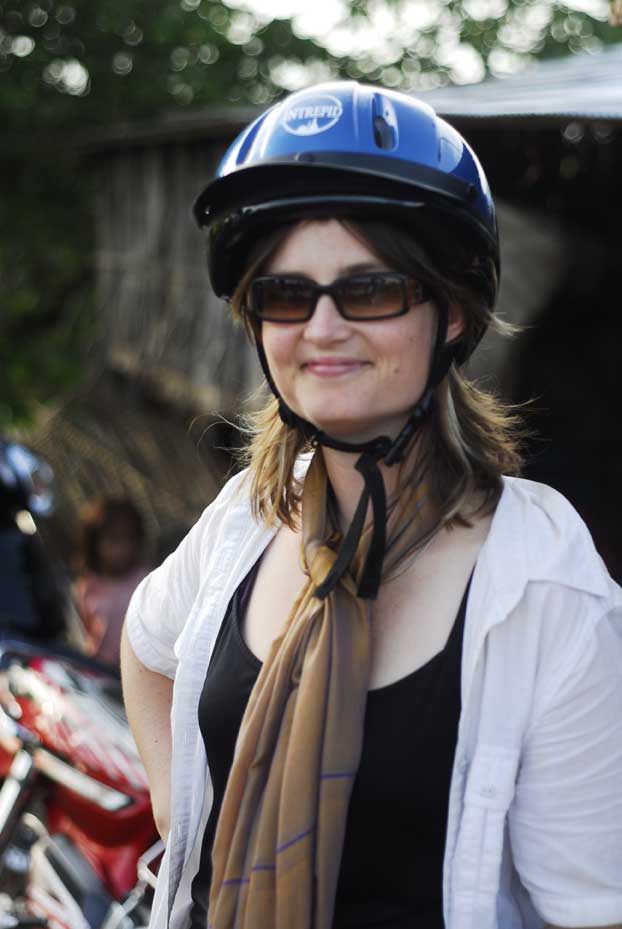
That’s a problem for later, though; the immediate challenge being whether to go on the afternoon’s optional motorbike tour around Battambang with Alice and others from the group, or whether to lie very still and perhaps go to sleep. I had until 3.30pm to decide and at about 3.20pm I had that ‘Yeah but when will I be back here?’ moment and joined the tour. I think also the free scarves, to keep dust off on some of the more provincial roads around, were a strong enticement.
As in Hue everybody had their own motorbike, rider, and helmet, but unlike in Hue there were now 12 of us, with Nak riding one of the motorbikes. That was one of his previous jobs, before Intrepid. He used to be a motorbike rider. My rider this time around was named ‘Rich’, although that must just be the English version of his name. We also had a guide, whose name escapes me at the moment, to explain to us all about the things we were going to see.
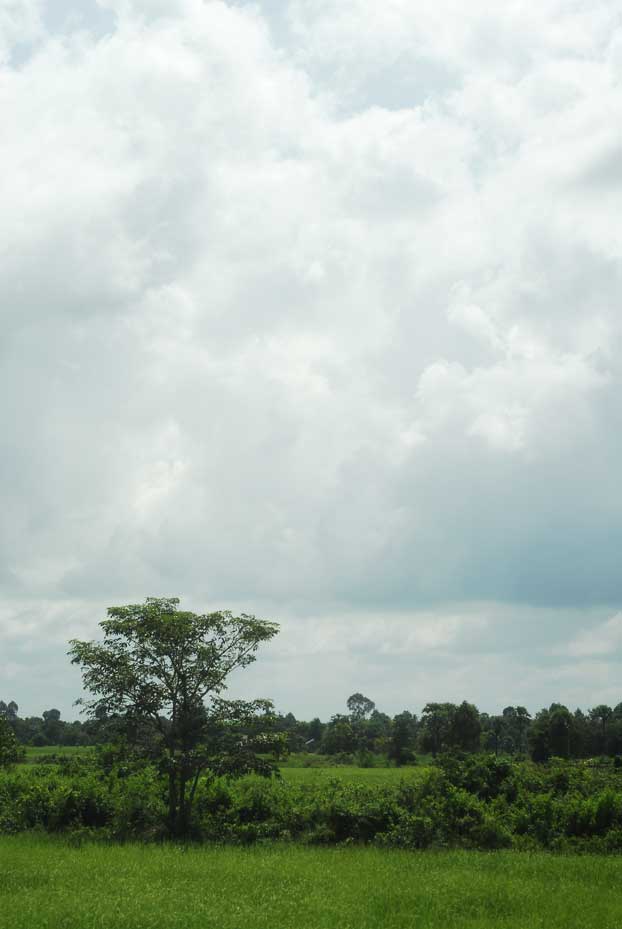
Rolling along on the back of a motorbike is quite a lot of fun. On the way out of Battambang the scenery changes rather quickly; one minute you’re in town but it’s clay-soil roads except they still have gutters and footpaths, then you’re on a dirt track as wide as a road and with more shacks than buildings lining the road, then you’re in field and the road is still wide but as bumpy as an olympic-standard bump-dodging course. Then after that you’re in the countryside, in narrow dirt lanes, zipping between shacks and villages.
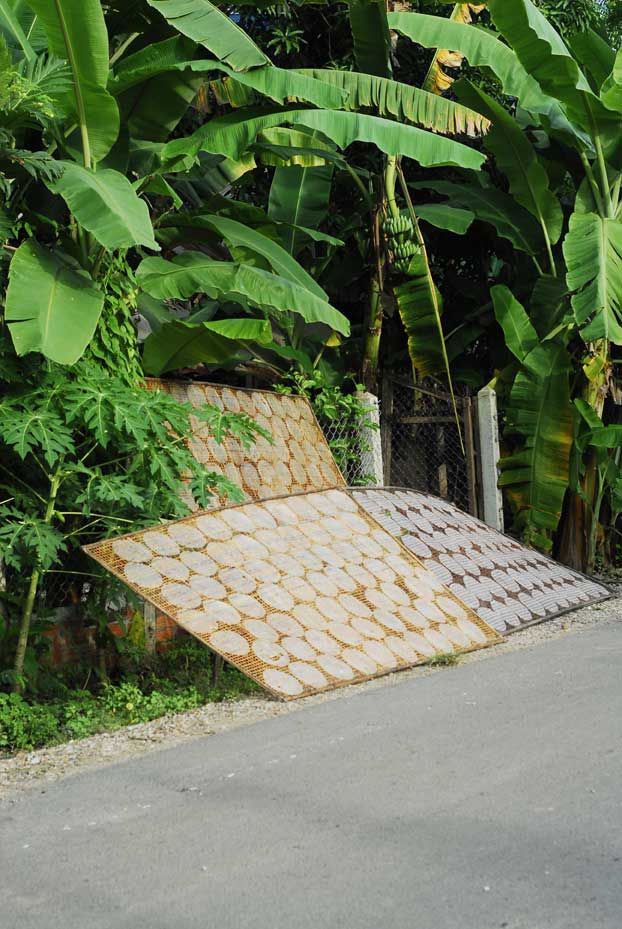
The first part of our tour was a demonstration of the process of making those thin rice paper sheets that go into making spring rolls. It’s pretty simple, really; you grind some rice finely to make flour, you mix it with water, strain it to make dough, steam it, and roll it out on bamboo sheets to dry in the sun. Sounds simple. Except that the finely ground rice flour is made more or less by hand (or with fairly basic machines), the rice paper will not dry in the wet season so the people that make the rolls have to work extra hard in dry season and have something else to do for the rest of the year, and the price of rice paper rolls is low enough that churning out several thousand rolls per day in dry season doesn’t buy you much more than a village shack.
All the same the lady making them was quite cheerful and didn’t mind a bunch of open-mouth tourists poking around and taking pictures.
Through the village we rode and then came out onto a wider, flatter road, running in between two green rice fields, with canals on either side. We stopped at a shack where the locals grew and harvested water snakes. A water snake is exactly what it sounds like. A large terracotta pot full of water snakes, that writhe toward the light when the lid is lifted off, is rather more entertaining. The thought of eating water snakes, either raw or rolled up and toasted, or in a herbal concoction to ‘cure’ arthritis, is not that entertaining at all.
We got back on the bikes and tallied-ho back down the orange road, through a smaller town and across a short but steep bridge, with levels sort of like steps but not quite, where most of the riders missed a gear. We turned left, through more bamboo plants by the river, and stopped near another much wider, flatter metal bridge, where there was a fish market. The fresh fish are bought from the Tonle Sap lake, which between wet and dry seasons can vary in surface area by more than a factor of ten. During the fish spawning season (June to October), no fishing is allowed in the mangrove areas around the edges of the lake, and this keeps everything sensible.
One of the things they do with the fish, and you can almost tell this by the smell coming from under the 15m wide by 50m long metal pergola, is making fish paste. Only they don’t have blenders or anything like that to do it. They just have long sharp heavy knives. They hold one in each hand and swing alternately, knocking the fish into very small pieces very quickly. Then they do it all again, and chuck it in a huge vat with buckets of salt to stop it going off, and wait around for two months or so until it’s all descended into a flat-topped grey mess the consistency of finely sieved clag glue. Very entertaining, really.
Further along, over more bumps and muddy patches and other obstacles calling for tidy riding, we stopped at shacks where sticky rice was being made. Sticky rice is something which everyone in Cambodia eats all the time but I’ve hardly ever heard of in Australia. It comes in different flavours somewhere between sweet and salty, depending basically on who makes it. But the real show is how it’s made. The ingredients are stirred for hours and hours, and when they are thick enough they are put inside your standard bit of bamboo; a fire is lit under the bamboo and the outside goes black. Bamboo is really quite thick; cutting off the blackened part leaves a cylinder strong enough to go in the bottom of your bag but thin enough to be peeled when you need to access the tasty rice within. Literally, peeled like a banana. Our guide explained about how people going on long bus trips would often take some sticky rice with them, because it’s very filling. And with salt and sugar you would be able to avoid dehydration.
The novelty of peeling the bamboo sides down is fun; but it tastes good and is solid enough to be easy to eat as well.
Final stop on the fresh food tour of the Battambang Countryside was another hut, near a metal bridge similar to the one by the fish paste ‘factory’, where 5 men and women were hard at work making fresh rice noodles. It doesn’t sound complicated, but again, in the absence of a nice steel machine to churn noodles out for you, they had themselves set up with baskets for rinsing and for the individual orders – people had to come and order batches otherwise they wouldn’t be made – and a big wooden bowl with boiling water in it, and a huge wooden tub with the dough. The noodles get squeezed out through a plate (presumably with noodle-shaped holes) into the boiling water, which seals them in the right shape, then pulled out in a mesh rinsing basket, which they take over to another bowl of water, to run cold water over. This done, the ladies sitting on the table get their hands involved and plait the noodles into rings. The rings go into wooden mesh baskets, are weighed, and then the order is ready.
I forget what the price of a kilo of fresh noodles is, but it’s probably not enough, for what goes into it.
The sun was trending downward; we got back on our motorbikes and motored back into town, through more bumpy roads and past makeshift shacks and along the edges of the river, bamboo all around. At the hotel we took all our pictures of our riders and then filtered up to the rooftop for a cold beverage, which we had the pleasure of adding to our Room Tab, and descended at seven for dinner at a local restaurant called ‘The Smoking Pot.’ Nak didn’t mind us knowing that a few years ago he bought tourists here for a different reason. Maybe it was legal then, or illegal but the government had more important things to enforce. Anyhow, THE ONLY thing I had for dinner was a very good and very spicy vegetable soup, in a sort of Thai style. Nak wouldn’t be the only one, we detected, who has come and gone through Thailand; the Thai influence shows up regularly.
This was the same restaurant we would be having our cooking school at the following day, for those who were interested. Rumour was that you could even pick something off the menu, and be shown how to cook that. I wanted to know how to make Vegetable Tom Yam (which is soup) and Alice wanted to know how to make Beef Lok Lak, so we put our names down for the school, even upon threat that if less than the six (6) people booked did in fact show up, we would have to split the usual cost between us. Yay!
We walked back through the town, which was now almost entirely deserted, and took ourselves to the ANZ (?) Bank, where the door of the room with the ATM in it had frosting on it. Stepping into the ATM booth, it was as I suspected Arctic.
At the hotel we put our sticky rice in the fridge for tomorrow morning; turns out sections of Bamboo do look odd inside a fridge.
Greg