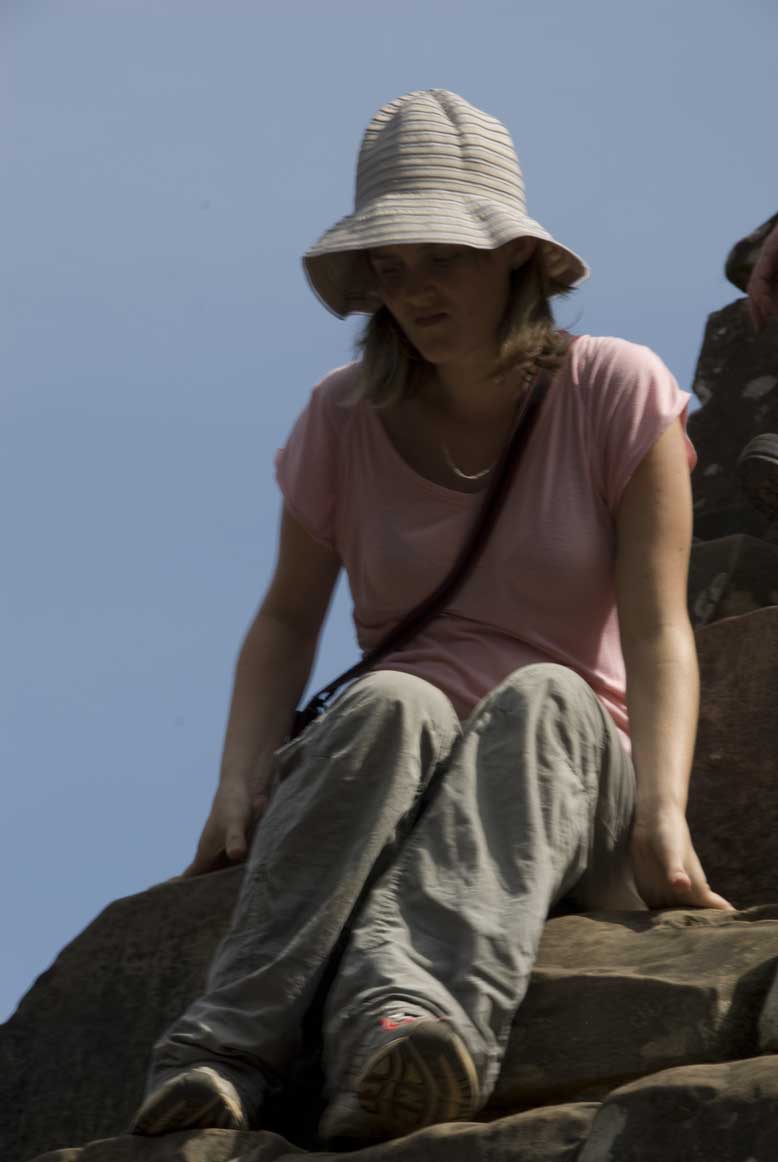
Today, we knew, we would be off to see one of the World’s greatest temples. And it’s largest.
Angkor Wat.
But it’s not one temple; well Angkor Wat is one temple, but around it are many many others, forming a vast complex. And it is the sum total of all these splendours that has meant Angkor Wat is thought of as the Eigth Wonder of the World.
It was pretty exciting to be in the bus waiting for something like Angkor Wat to come around the next corner. But before it came we went past all the extremely shiny hotels which are set up more or less at the entrance gates to the park. If you fly into Siem Reap, go straight to the flashy hotels, and spend a couple of days exploring only Angkor Wat, you shouldn’t be allowed to say that you’ve gone to Cambodia, because you haven’t really.
Around the largest and/or most important temples there is a large stone wall, which used to come in handy when Angkor Wat was used as residence, not just for the royals but for the people as well. I think we already explained somewhere that Wat mans temple; Angkor means city. So Angkor Wat, according to Nak, means the ‘Temple that became a City’. But don’t get confused at this early stage; nobody actually lived in Angkor Wat or any of the other temples. They lived around them in wooden accommodation which seems not to have survived to the present day. If anybody lived in the temples it was the Gods themselves; that was what they were built for. That way, people could feel that the Gods would be looking favourably upon them, walking among them, extending their influence and that type of thing.
And… entirely by coincidence… today is the 100th day of our holiday. Which is way cool.
Meanwhile we had to get off the bus to have our pictures taken for the entrance tickets, which cost $40USD for three days or $60USD for a week. And of course everyone’s ticket photos were rubbish and made us look like rapists. And in some ways we are because the money that tourists pay to enter the temples during the day goes to a Vietnamese company, and if they enter at night the money goes to Thai and Japanese companies. Now while there was a war on (so that’s between 1970 and 1993) you can see that there would have been a need for someone with spare cash to look after the temples. The Cambodian government, if there had been a stable one at the time, wouldn’t have had those resources.
‘So how long will it be,’ we asked Nak, ‘before the temples are given back to the Cambodian Government, or sold back?’
A long time was his answer; they’d be better off, apparently, in the soft patrician hands of UNESCO.
I could try for a sensible adjective like ‘majestic’ or something to describe the bridge and the South Gate but naturally that wouldn’t be good enough. You don’t exactly feel like you’re going back in time driving through those gates, but because it’s 900 years old it is different to the world outside. We had gotten a relatively early start to beat the heat, and got off in front of the Bayon Temple at about 9.30 in the morning. The Bayon Temple is at least 100m long on each side, has three levels, and is clad in stone carvings displaying, amongst other things, the procession of King Suryavarman after defeating the Vietnamese, and battle scenes from the same. Siem Reap, in fact, means ‘Siam Defeated’ and actually refers to a battle between the Khmer and the Thai people, which the Khmers won.
‘So that’s what the name Siem Reap means, is meaning Siam Defeated,’ says Nak, ‘but don’t call the Thai people that you meet now Siem, Siem means ‘Slave’ and they will be upset with you.’
Nak also took great joy in pointing the part of the battle procession where there is a wife carrying a turtle which will make a good turtle soup later on, but the turtle got other ideas and bit the husband on the bot, so the man is turning his head around saying to the wife,
‘Hey what the hell you doin’ to me baby, can’t you be more careful?’
On the southern side the stone carvings showed Khmer fishermen using nets and poles to procure lunch, while skirting around crocodiles. It also shows a couple of guys having a good look at the inside of a crocodile’s stomach, while the crocodile is having a bit of trouble with those bony bits called legs. Further on it shows pregnant women laying down under shady huts and giving birth, and men boiling herbs and mixing medicine to assist this process. In other words, it shows doctors in a maternity ward – and a maternity ward made out of bamboo and banana leaves is still a maternity ward.
Out on the dust main road, elephants strode past with tourists on baskets high up on their backs.
Then you turn in one of the doorways and the two higher levels come into view. The Bayon Temple is possessed of several hundred metres of magnificent carvings on it’s outer but the real fun is the set of huge mystical faces protruding from the stone towers on the top level. These towers guard the inner part of the Temple, a courtyard on which there are steps leading up to the main altar, which is round, and sits in the middle of a cross shape formed by turrets with small altars in them. One of them even contains a small Buddha statue…
After half an hour of looking around the main altar, we went down the steps on the other side and moved on. Across the road, under a stone enclosure, is a giant Buddha statue, draped in orange.
Past that, through trees you can see two large rectangular ponds with a long walkway running between them up to a pyramid shaped Temple named Baphuon. This one you cannot actually go inside because it’s under restoration, but you can go through the entrance gate and look at the main pyramid, fenced off, with uniformed workers creeping up and down the sides making it all better. There are covered plastic information boards under a hut explaining about how the temple became overgrown with trees and vines, and then had a little collapse because nobody realised that under the stone, inside the pyramid, it’s actually full of sand. So now the French are paying for the restoration.
Over a small hill and through a stone gate, and a throng of painting, book and trinket salespersons is Phimeanakas. The rumour is that this small but steep-sided temple used to be where the king went to meet his concubines; the steps on the side are so steep that the king had to be sufficiently energetic to climb to the top. They don’t look that steep in the photo, but also you can’t see just how thin each step is; you have to kind of crab-walk up. There are some easy metal stairs installed on the other side but they’re no fun at all.
The altar at the top of Phimeanakas is crumbling a bit but there’s nothing wrong with the view. Well, there is one thing wrong, namely tourists from a country which will remain anonymous moving the Do Not Climb sign so that they can CLIMB up on to the edge of the altar and get their picture taken. Who wants a photo of some fat sweaty scarf-wearers anyway? So we picked up the sign and moved it back in front of the Anonymous Tourists, so that it would be in their picture.
Down the other side of Phimeanakas we crossed the road back over to the Elephant Terrace and the Leper King Terrace. The Leper King Terrace is actually kind of like a maze; from outside it just looks like stone walls decorated with carvings, and inside the walls are panelled with stone engravings as well. There are stairs up each side, and on the top, where the gaps between the inner walls are filled with dirt, there is a small statue of a Buddha. The Leper King Terrace was built by a king who actually turned out to have leprosy, when construction was finished I don’t think he stood up and said ‘I hereby proclaim this to be the Leper King Terrace’. The Elephant Terrace is much bigger, maybe 20m wide and 300m or more long, adorned with various statues of elephants.
The two terraces are across a small road from each other; the small road joins a main N-S road, and from the top of either terrace you can look to the west at what would have been the city and it looks like a pretty good spot to have a huge celebration of some kind while sitting up on top of your Elephant Terrace and reminding yourself that you are King of Everything.
Having covered that lot, we bussed it back to town about 12.30, so that we could avoid the heat of the day, and stopped only for a ‘Kodak Moment’ at the South Gate. At the hotel some people headed for the pool, others went for a lay down, and a third group figured lunch would take ages to arrive and sat down under the shade. We had detectived that somewhere in town there is a Tigre de Papier restaurant, and that food for the hotel is delivered from this restaurant. And that’s why it takes ages. Which it did.
At 3pm we ‘reconvened’ and drove back through town to the daddy of them all; Angkor Wat.
The book I bought informs us that the outer wall is 1025m x 802m. Around the outer wall is a 190m wide moat, so the whole lot is 1.5km by 1.3km. In short, it’s absolutely huge. One approaches via a causeway on the Western side of the temple, which was not included in the original design. I guess there must be come corpses somewhere at the bottom of the moat; it’s always full because it’s irrigated by a huge reservoir.
There are three entrances at the main gate; one for servants, one for people, and one bigger one in the middle for royals; we went through the gate for people, on the right. In the entranceway there is a large statue of Vishnu, the one with the many-arms, and past this you come down the stairs into the grass inner courtyard. Running right down the middle, from the Royal Entrance, is another stone causeway that takes you all the way to the main walled temple. On both sides of this causeway are two matching stone buildings, again cross-shaped, about 20m long each, which are referred to as the libraries. In front of each library are large reflective pools, in front of which one crouches to get ‘that’ photograph of Angkor Wat, with the towers reflected and what-have-you.
However the main event is the size, detail, and epic nature of the carvings around the outside of the main temple. The eastern side (the Churning of the Sea of Milk, which covers the Hindu story of creation) was being restored, so we started on the south side. The carvings here cover the historic procession of Khmer kings and commemorate various famous victories; the second half of the south side shows the ‘Heavens and Hells’, or in other words it shows the Hindu scheme and Crime and Punishment. Adulterers on the right for whipping, murderers on the left for sitting neck deep in excrement. That type of thing.
Around the eastern side we entered the main temple, looking left and right along the narrow stone hallways, light bands coming through the windows. In each window there is not glass but ornate stone pillars, which were actually lathe-turned into their unusual shapes. In the central courtyard, we were given half an hour to look around, but couldn’t go into the five-part altar in the very middle as some of the towers have been struck by lightning in the last few years and repairs are ongoing. So we sat and imagined what it would have been like 900 years ago when the temple was complete and the World was created by a sea of milk. And it wasn’t that hard to imagine.
Walking back to the moat to meet Nak, we were amused to see photographers about three deep and 45 wide, spread along the edges of the both ponds, all taking exactly the same picture of the central towers. I was aware of the need to get back to the bus in time to go up one of the nearby hills for s sunset view, and was literally running around trying to get photos from the various angles that I wanted to try, which I confess was a lot of fun. At 5.25pm, half an hour after we were let loose, we assembled on the causeway, halfway along, and decided that we weren’t going to make it for sunset tonight. But the discussion over whether we would like to get up early to see sunrise at Angkor Wat tomorrow was a short one.
It went like this: ‘Yes’.
In the bus everyone was quiet and must have been carefully treasuring each memory of Angkor Wat and storing it somewhere they would never forget it.
With an early start coming there was no chance whatsoever of going downtown for dinner; instead we just parked on the comfy seats next to the pool and had a beverage while waiting for dinner to be delivered. Sufficiently relaxed, we took ourselves to bed.
Greg